
The Curious Tale of the Most Powerful Microcomputer of Its Time — The Amiga at 40 Years
“Commodore buy QL beater”, said Personal Computing Today in November 1984, referring to Sinclair’s hugely unsuccessful QL machine. Byte Magazine in April 1984 had a small news story about how “Joystick maker Amiga Corp. is developing a 68000-based home computer with a custom graphics coprocessor.” Both outlets were excited by the prospect of a microcomputer that would be much more powerful than anything currently on the market, but in both cases, were quite reserved about it. Many other publications had a similar “we’ll believe it when we see it” attitude — after all, who would believe a company that had released a couple of joysticks and a few Atari 2600 games would be launching a world-beating computer?
To answer the above question, we have to go back a little further in time, to 1980, when chip designer Jay Miner grew disillusioned with the way things were going at Atari and decided to leave. Miner was highly regarded in his field, having created the graphical chip for the Atari VCS and most of the chipset for Atari’s 8-bit range of computers. He wasn’t a man who liked to sit still, however, and before the Atari 800 computer was even released, he was eyeing up shiny new 16-bit chips and trying to encourage his employers to start designing something based on those. Atari’s opinion was that their 8-bit system would be good enough, and didn’t want to start working on a successor so soon. This frustrated Miner, who could see the pace that the computer and videogame industry was moving at, and he quit before his magnum opus of the time was released.
Two years passed, with Miner having pivoted to working in the medical field for Zimast, where he patented two designs for low-power chips to be used in pacemakers. These were incredibly significant advances, as earlier pacemakers were usually bulky devices that couldn’t last long on battery. This meant that either they would need external batteries that had to be carried around, or they would have to be replaced with dangerous surgery every few years.

Miner and his Cockapoo Mitchy, who joined him in the office most days and was considered an important part of the Amiga's engineering team.
Saving lives is all well and good, but Miner’s dream for quite some time had been to create a home computer using the Motorola 68000 processor. This was the main reason he had left Atari, after all. So, when a phone call came in from his former colleague and Activision founder Larry Kaplan, the enthusiastic engineer jumped at the chance to help him form a new company with the aim to create such a device. The plan was to create it in the form of a low-cost games console, with a view to being able to expand that to a home computer later. Tonka’s Vice President of marketing, Dave Morse was brought in as CEO, and the trio founded Hi-Toro, the company which would later become Amiga Corporation.
By the end of 1982, Kaplan had already left, with his position as Vice President of the company going to Miner just in time for the change of name to take place at the end of the year. Hi-Toro was deemed to be too close to the name of a Japanese lawnmower company, so the Spanish word for a female friend was chosen instead. Jay has gone on record to say that, at the time, he felt naming a company trading so heavily in the English-speaking world after a Spanish word was a mistake. He’s also been very open in stating that he is glad he was wrong about that!
The powerful home computer vision wasn’t something that the fledgling Amiga talked about much; This was very much intentional. It was clear that the process of designing and building the machine would take a while, and it was decided that in the interim, a division would be set up to make peripherals for Atari’s VCS. This would avoid the risk of letting their competitors know what they were up to, and thus giving them a chance to outdo them. After all, Amiga was a small company, with funds much more limited than the big players such as Atari, Commodore, and IBM. If one of those larger companies knew what was coming, they would have the budget available to have teams of dozens of engineers working on a machine to compete, and Amiga wouldn’t be able to keep up with their handful of staff.

The prototype of the Amiga was just a touch larger than the final machine!
The other advantage to making Joysticks and Atari 2600 games was that they could be used to both boost Amiga’s image, and help fund the development, making the company less reliant on outside investors. In 1982, the videogame market was booming, and envisaging this trend continuing, Amiga knew that they would be able to prop the company up like this until they were ready to launch their own machine in 1984. It was a perfect plan, and nothing could possibly go wrong. Or could it?
What Amiga Corp couldn’t have realised was the North American videogame crash was on the horizon. Going into 1983, they were expecting a profit, but with the market getting saturated with poor-quality shovelware, retailers were seeing high numbers of returns, lower sales, and unsold stock clogging up their stores. As a result, orders for videogames and peripherals plummeted, and with them, so did Amiga’s expectations for a good year. A planned cassette add-on for the Atari 2600 and a number of game bundles that had been planned to go with it had to be cancelled.
The company still had a controller ready for release at the time: the joyboard. Very much like a rudimentary version of Nintendo's balance board, it was a joystick you stood on and shifted your weight on in order to trigger the four directions. You could also plug in a regular joystick if you needed a fire button. Olympic skier Suzy Chaffee had already been enlisted to market the device, and production had started just before the crash, so Amiga released it anyway in order to try and at least minimise their losses on it. There was one game released alongside it for the Atari 2600: Mogul Maniac, a game featuring slalom skiing (hence Chaffee’s involvement).

The Joyboard and Mogul Maniac, the only game released for it.
With poor sales and little enthusiasm from gamers, the joyboard itself has all but faded into obscurity, but it did live on via Amiga’s computers. One of the test programs in use internally at Amiga was a game called Guru Meditation, which involved sitting cross-legged on the Joyboard as still as possible, trying not to trigger any of the buttons that responded to movement. The longer you could do it, the closer the meditating guru on screen would get to the top, and the better your score. This was never a publicly released game, but crashes on the Amiga range would give the now-famous “Guru Meditation error” screen, which took its name from this game.
Throughout 1983 and into 1984, engineers at Amiga would continue to work hard on the chipset for their games console, but money worries would get worse for them. Staff were laid off, contractors weren’t retained, and many weren’t paid on time. They eventually chose to pivot from a console to a home computer, but even so, things weren’t looking good. The computer was unlikely to be finished in time for a 1984 launch due to the lack of funds to hire more engineers. In fact, if it was to be released at all, another source of money would be needed.
Eventually, a deal was struck with a major computer manufacturer, who wanted to make a computer based on the Amiga games console chipset and thus was born the “Atari Mickey”. Wait…what? Yes, there’s another interesting twist in the tale here, which is that Amiga’s potential saviour initially came in the form of Miner’s former employer Atari, who wanted to follow up the Atari 2600 with a new console in the hope of moving on from the console, which by now was waning as a result of both age and its association in North America with the declining fortunes of the industry.

Would this have been an Atari computer had things gone differently?
A letter of intent was signed in March 1984, and Atari gave Amiga $500,000 for signing this letter. It stated that there would be an agreement formed between the two companies licensing the Amiga chipset for an Atari games console and arcade machines, with Amiga retaining the rights to a home computer (although Atari would be able to make an add-on to convert their games console into a computer). The two would be intercompatible, giving Amiga a head-start in acquiring gamers for their machine via the much more well-known company.
Even before the deal was signed however, Atari started asking for changes; most notably, they wanted non-exclusive rights to make a computer from the outset. Whilst the rights for this weren’t in the original letter of intent, Amiga knew that Atari was well aware of its lack of choices in the matter, and if they didn’t sign an agreement or pay back the loan by 10th of June 1984, Atari would gain full access to their chipset design (which was being held in escrow as a safety net for Atari, ensuring Amiga didn’t just take the money and run). The letter of intent allowed Atari to make computers from 1986 onwards, but they were already working on the computer they planned to release as the Atari 1850XLD, codenamed “Mickey”. With development on Amiga’s computer expected to continue into 1985, it was looking like they wouldn’t have exclusivity for very long, if at all.
To compound matters, it was common knowledge that Atari’s owner, Warner Communications, was getting cold feet about the world of videogame hardware, and rumours were abound that they were about to sell the computer and console portion of their business to Jack Tramiel, founder and now-former CEO of Commodore. Tramiel was a notoriously cost-conscious man, and this was instrumental in making the Commodore 64 and the PET range of computers as popular as they were. Because he was very strict on keeping costs down, he was able to make his machines viable for the mass-market at a time when home computing was only just starting to become affordable to the average consumer. He was also known to be particularly aggressive in negotiations, and Amiga would be unlikely to stop Atari under Tramiel from railroading through the creation of a competing computer, effectively putting them in immediate competition with a company they couldn’t hope to outdo, and relegating them to being just a chipmaker for Atari.

The 1985 Amiga Model had a tick for the logo rather than the 'A' that was more common for later models.
Another plan was needed, and fast. Dave Morse realised his only hope was to somehow pay Atari back that half-million-dollar loan before the 10th of June (just a few weeks away), which would free them from proceeding to a formal agreement. He spoke to a few interested parties who had seen the prototype at the 1984 Consumer Electronics Show, but the one which really stood out was Tramiel’s former company Commodore, who was also very conscious of their founder’s impending purchase of Atari, and was looking for a way to quickly follow up the Commodore 64 and maintain their market position. They had been working on a number of prototypes internally, including a Unix-based business machine and an early laptop design, but with many of their best engineers leaving at the same time as Tramiel, these projects were suffering.
Amiga still didn’t particularly want to license their technology to be inside another company’s computer. But Commodore came up with a way of working around this: instead of a licensing deal, they would just purchase the company outright and Amiga would become a subsidiary of Commodore. It wasn’t the approach that Amiga had been initially looking at, but with a valuation of $23 million, it seemed like the best option for them (In contrast, the deal with Atari had been calculated to be worth around $4 million!). Morse hand-delivered a check for $500,000 plus interest to Atari, who didn’t particularly want to accept it, but reluctantly had to.
With their new owners injecting another $20 million into development, the Amiga became much easier for Miner and his team to create, and started to develop a head of steam. It still wouldn’t be ready for 1984, but it would be possible to launch in 1985, and this was what they were now aiming for. Changes were made along the way, including increasing the amount of on-board memory, and a change in operating system to a version of TripOS instead of the originally intended subcontracted custom OS. Many of Amiga’s engineers weren’t as fond of this plan B operating system, but with deadlines to meet, compromises had to be made.

The new home of the Amiga.
All of this brings us to the 23rd of July 1985, when Commodore held a massive gala event to show off their new machine to the world. The Lincoln Center in New York was hired, as was a full orchestra, former Blondie singer Deborah Harry, and world-renowned artist Andy Warhol. The latter two celebrities were brought on board as part of a demonstration of the Amiga’s visual capabilities, with Warhol creating live paintings of Harry as part of the show.
As a side-note, the paint package in use on that night, which was still in development, was known to crash when the flood fill option was used. Warhol almost immediately went for this option, emulating his signature pop-art style to colour Harry’s image in vibrant red and yellow hues. Some have said that he was entirely unaware of the crashing, but others have said he was made well aware of the bug in advance, but he simply chose to ignore all advice and use the function anyway. As it turns out, it behaved absolutely fine. The Amiga he was using, clearly understanding the importance of the event, performed the task without issue and nobody was any the wiser.
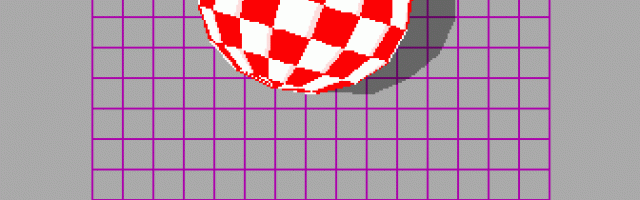
That event saw Commodore show off things on their computer that other home computers simply couldn’t do. Graphical demos, including the now ubiquitous “bouncing ball” demo, were shown off running in dedicated windows, with multiple demos playing simultaneously. In 2025, this might seem trivial, but at the time, the idea of multitasking several graphically intensive operations was astounding. It’s worth bearing in mind that Windows 1.0 wouldn’t arrive until later in the same year, and Apple’s “System 2” on the Macintoshes of the time wasn’t capable of multitasking at all.

Andy Warhol and Deborah Harry at the 1985 Lincoln Center launch of the Amiga.
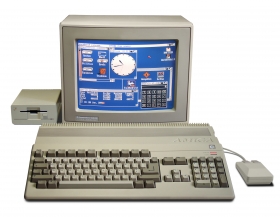
It would be a few more months before systems started finding their way into businesses and the homes of consumers, and it wasn’t an overnight success either. In fact, you would be hard pressed to find too many people who favour the launch Amiga model over the more popular A500, which would come two years later. Reliable worldwide sales figures per model are impossible to find, but figures published in Germany in 1993 showed that the A500 outsold the A1000 around 40-fold. But regardless of the slow-burning of the machine’s success, there’s no doubt that the Lincoln Center event was the birth of one of the most iconic and well-regarded home computer series in the history of computing.
There is so much more to the story than I can cover in this one article. Whilst this serves as a brief history, the whole story could be a book in itself. In fact, there have been a few written, and I thoroughly recommend checking out Brian Bagnall’s Commodore: The Amiga Years, which was one of the most useful resources I found in my research for this article. Special mention also to the Atari Museum, which has done a fantastic job of preserving historical documents and information on a lot of the details of the aborted Amiga licensing deal.
The Amiga continues to live on to this date, of course, with new models being created under the AmigaOne name by hardware manufacturers A-Eon and ACube Systems. New games are still created by dedicated developers, and even miniature versions of the system are being released by cash-in kings Retro Games Ltd. The legacy of the Amiga is still strong after 40 years, and it’s unlikely to slow down any time soon. Happy birthday to the little home computer that could!

An unknown attendee's invite to the gala launch event.



COMMENTS