
One-Eyed Likho Review
We all have fairytales and scary bedtime stories that have stayed with us since childhood, and the early 19th-century Slavic myth that inspired Morteshka’s One-Eyed Likho definitely falls into the spooky category. This first-person horror adventure follows the footsteps of a blacksmith, simply called Smith, as he voluntarily goes looking for evil in a dark forest, a choice that immediately left me unsettled and deeply curious to see what he’d find.
I will note that if you feel like yelling at the Smith in the same way you’d chastise a movie character stepping down into a haunted basement, you’re not alone! I certainly felt confused why someone would find terror or danger a reason to move forward, when a main character’s motivation is usually escaping trouble. That wonder led me down a rabbit hole of research mid-playthrough, learning as much as I could about the titular folktale, which revealed that the devs were staying true to a version of the story while also twisting it into the game’s unique linear journey.

Having more context helped, but I have to say I had trouble grounding myself in the narrative the further I progressed. Much of the dialogue and notes yielded more questions than answers, though I do suspect there was some meaning and subtext conveyed in the Russian voice-over that I couldn’t pick up on with the English translation. That said, I could still appreciate the beauty of the poetic riddles and the somewhat spooky cat-and-mouse game we ultimately play with the Likho creature.
Still, it’s almost necessary that you go into it expecting a surreal experience that might not make total sense. As is typical of fables and folktales, deciphering the moral of the story (amidst the strange events) is what’s important, and One-Eyed Likho teaches a good lesson. The ending, in particular, is one I won’t forget.

For a protagonist who actively seeks out wickedness, it makes sense that your main tool is fire, a mechanic that unlocks early on in the game after you discover an always-full matchbook inside a mysterious cabin. Whether you need to clear debris from your path, illuminate a dark hall, or reveal the answer to a puzzle, lighting one of your infinite matches and throwing it at the problem is often the way to progress forward. You can even throw them at little Matryoshka dolls hidden throughout each level, which is quite fun.
Aside from moments when you need to run away from Likho — the mythical, single-eyed creature — you can explore at your leisure, reading scattered notes, uncovering codes to locked chests, and finding keys to the various doors blocking your way forward. The puzzles in each area are, unfortunately, quite dull to complete, with many taking little interaction or thought, as hints are clearly placed all throughout. The lack of discovery was apparent, especially since you do get a companion later on that fetches items for you or often states what to do the moment you arrive at a new area.

As mentioned above, you do get those more action-based sequences where you need to evade or escape the creature, and those were a bit more enjoyable, especially when you need to create fires to distract Likho. I did find that the slow base/sprint speed for Smith to be distracting, though, as it felt like I was underwater even while running. Perhaps the slower movement was meant to enhance the horror of encountering Likho, but it was mostly an annoyance.
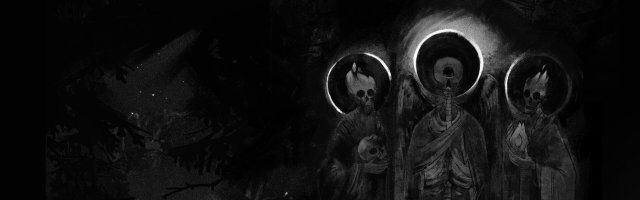
Visually, One-Eyed Likho’s monochromatic grey world is striking and unique. It adds to the surreal, dreamlike vibe while introducing a hint of eeriness to the atmosphere. However, much of the environment blended together and the limiting exploration left much to be desired; all in all, there’s nothing too memorable about the world other than the colour scheme.

Having said that, the design of the titular Likho is a great accomplishment, bringing to life the mythical being in a way that captures the grotesque appearance: a towering, nearly skeletal old woman with stringy black hair, talon-like fingertips, and a lone eye in the centre. Her creepy movement brings it all together; the short spasms and unnatural postures are nightmarish.
That’s the extent of One-Eyed Likho’s horror, though. There’s little to no tension developed across the playthrough, and what spooks are present all happen early on, as the game uses a jumpscare tactic of placing something behind you multiple times for the first hour (before abandoning that strategy entirely). The soundscape isn’t used to its fullest either, creating a flat auditory experience when it comes to ambience and subtle sounds.

Sitting at a little over three hours, my playthrough of One-Eyed Likho was just decent. There are more engaging and immersive creepy walking sims out there. I wouldn’t say this title is suitable for anyone looking for a puzzler or to be scared; it’s much better suited for those seeking a strange, somewhat eerie experience or those wanting a very light and short horror adventure.
One-Eyed Likho (Reviewed on Windows)
Game is enjoyable, outweighing the issues there may be.
One-Eyed Likho is inspired by a unique folktale and delivers a surreal experience, but its lacklustre puzzles and lack of tension make it just an okay game. Granted, it is interesting enough to stay to the end.




COMMENTS