
Shinobi: Art of Vengeance Review
As soon as you begin playing Shinobi: Art of Vengeance, you hear the classic SEGA (Say-ga!) audio. This instantly took me back to playing the Shinobi title on the 3DS back in 2011. This ninja series has been around since 1987, with Joe Musashi being the protagonist in the main entries of the franchise. I was excited to see if Art of Vengeance feels like a worthy addition to this long-running action-packed series, or if it would feel like a totally different series altogether.

Right from the beginning, Shinobi lets you select how challenging your journey will be. From Novice, which is the easiest setting, where enemy damage is halved and respawns place you near to where you died, to Apprentice, the enemy attacks take off more health and your attack is weaker, to the default Shinobi mode. If any of these aren’t to your liking, there is a custom option where you can select a variety of settings to make the desired difficulty.

Our story begins with Joe Musashi, the legendary ninja, working as a mentor to a young apprentice named Tomoe. He is teaching her the ways of the Oboro clan to fight against the evil ENE Corp, led by Lord Ruse, who, like every good evil organisation, is trying to take over the world. Your journey to defeat Ruse will take you to a variety of locations, like a Lantern Festival, the mountains, and down into the mines. Each place has a variety of enemies to battle and a large boss you will need to face off against.

The combat system in Shinobi: Art of Vengeance is quite deep, with a variety of offensive attacks available to use. Your main moves include a jump/double jump, light and heavy sword strikes, and the ability to throw kunai at enemies. These can be chained together to create powerful combos that will do massive damage to the enemies you are fighting. You can also use Ninpo attacks or the ultimate move, called Shinobi Execution, that can take out an entire screen of enemies, but your execution gauge will need to be filled by defeating enemies before you can utilise this move.

As you explore the stages, you find yellow boxes that, when destroyed, give you extra kunai or some health. You can exchange the Oboro Relics you pick up (five in each stage) to expand the collection of wares that the shop offers. These range from new attacks like a Double Slash or Knee Attack, to elemental techniques like Water Ninpo or Karyu, a ninjutsu that ignites everything on screen. Each of the attacks you can purchase has a Damage rating, so you have an idea of how strong they move will be.

The levels you visit are linear, but are packed with secrets if you wander off the main path. You have access to a stage map that is filled in as you explore the area and will mark the position of locked gates, levers, or hidden relics, so you will be able to revisit these locations when you learn new skills. Red swirling portals that resemble whirlpools show exactly where the enemy will spawn, giving you a chance to move out of the way, and optional challenges like Elite Squad battles reward players with rare upgrades like the Super Shocker once you clear out all the foes.

For me, the boss fights were a highlight in the game. Each of these foes is one of Ruse’s lieutenants, and they are introduced with an awesome-looking title card. The music during these battles was so good and really stood out compared to the normal stages. Early encounters in the game include a fight with Ghost Samurai and a battle against a demon-like ape who is the one responsible for burning down your village.

When victorious in these boss battles, you are rewarded with new attacks and perks like Max Health to make your shinobi stronger. You will also meet Ankou, the Grim Reaper, who works with Musashi to stop Lord Ruse and challenge fun bonus stages where you ride your faithful dog, Yamato, chasing colossal beasts while hurling kunai at targets. Every ninja needs a good doggo…

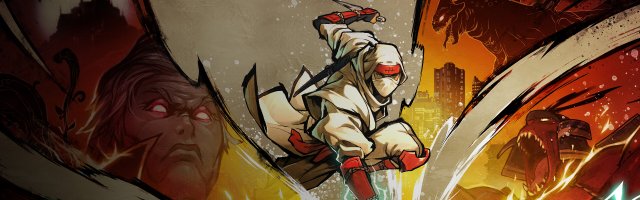
Visually, Art of Vengeance looks incredible. The foreground animations, lens flares, and a hand-drawn pen-and-ink aesthetic make each stage pop and bring this 2D platformer to life. Though at times, the scenery in the foreground looks cool, but blocks your view of yourself and of enemies. The mix of traditional Japanese art with modern effects gives the game a unique identity compared to other side-scrollers.

Not everything in Shinobi: Art of Vengeance hits the mark, though. Control-wise, I found that the platforming sections didn’t feel as crisp as I would like. Jumping onto a platform felt a little bit slidey, like you weren’t able to land on an exact spot, especially when you were moving fast and dashing between collapsing platforms or during chase sequences where speed matters. Combat offers more variety than something like Ninja Gaiden, but to use these special moves, you will need to make sure the required gauges are filled, or you can’t use them.

Shinobi: Art of Vengeance brings back memories of the early titles in the franchise, but has also updated a lot in this new addition to the series. The variety in the combat system, gorgeous hand-drawn visuals, and challenging boss fights make it a worthy addition to the Shinobi legacy. While the platforming can feel a bit frustrating at times and some of the special attacks tricky to utilise when you really need them, overall the game is a challenging mix of old-school ninja action with modern game design, with checkpoints frequently saving your progress.

SHINOBI: Art of Vengeance (Reviewed on Windows)
This game is great, with minimal or no negatives.
Shinobi: Art of Vengeance is a beautiful-looking game that feels like a great addition to the series. It is challenging and full of non-stop ninja action.




COMMENTS