
Shujinkou Review
Hello, my name is Gary, and I love videogames. Or, to put it another way: Kon'nichiwa. Watashinonamaeha geirīdesu. Bideogēmu o yatte imasu. See, I have been learning Japanese — sort of. I’m not very good yet, and it will probably be years before I am fluent, but all I really want is to play old SNES JRPGs that haven’t been translated, and maybe Segagaga at some point, so there’s no hurry. I’ve been trying to learn on and off for a fair few years, and frankly the Duolingo owl is pretty sick of my lack of commitment by now, so I decided to see if perhaps I might get better results with Shujinkou, a JRPG that promises to teach you one of the hardest languages to learn whilst you play.
I actually discovered this game a fair few years ago on Kickstarter, in a campaign that sadly never quite reached its goal. But the game’s primary creator, Julian M. Rice, is a resourceful fellow, so he pressed on and eventually founded Rice Games with his team of other talented videogame professionals. The end result is that, over five years on from the end of the Kickstarter, Rice Games has given us a dungeon-crawler of epic proportions, that also aims to help us learn in the process.
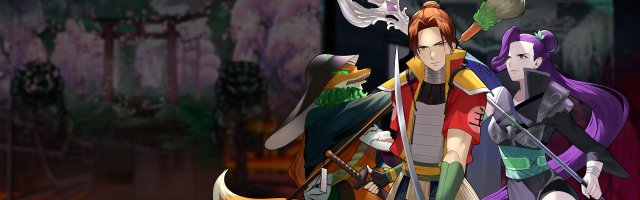
If you’ve ever played the DS classic Etrian Odyssey, then you will likely notice the similarities to Shujinkou. That mix of classic JRPG mechanics and quasi-3D dungeon crawling is the order of the day here. Indeed, Rice has said in interviews that he got tired of waiting for a new entry in the series, so decided he would have to make one. There’s a huge amount of charm to the style, and it is complemented by a lot of visual-novel-esque story-building scenes alongside those dungeons, which gave me a real fondness for the characters.

Some of the wording felt a little bit forced rather than conversational, but that seemed to be more because of the need to shoehorn in learning elements. In the early days of learning a language, you aren’t going to be starting with complex narratives, so it was necessary to start with more basic things like learning about making tea. In much the same way as a police procedural might have the characters explaining something that real law enforcement would just take for granted is common knowledge in their field, so Shujinkou has to spell out a lot of things (often literally) as you progress. This dies down over time, as the game starts to get a feel for your grasp of the language.
It’s that teaching element which really sets this game aside from its peers. There are a number of ways that it educates you. Firstly, the game’s menus can be in plain English, furigana or kanji, and this can be different for a highlighted menu (I chose to have the menus in English, with the highlighted option in furigana). Secondly, there are key terms and phrases highlighted throughout the story, with the option to get more details and pronunciation guides on top. The third, and most interesting, way that Shujinkou teaches is through the combat system itself. Initially, battles are the usual JRPG turn-based affair, with standard attacks and defence, bolstered by your weapon and armour stats. As soon as you get to the first dungeon, though, the Kanakae orb mechanic is introduced. You collect these orbs as you progress through the game, which all relate to specific kana — essentially, a single kana represents a syllable in a word, Japanese doesn’t have letters in the sense we use them in Latin-based languages, for example — but also an element.
Like in many games, monsters are strong or weak against particular elements, but the kana represented are the most important part. When you first encounter enemies, their names are obscured. When they attack you, though, their name is written in romaji (a system that approximates Japanese words using the Latin alphabet), so you can use that to work out which Kanakae orbs you possess contain syllables from the creature’s name.Let’s say you’re fighting a chicken, in Japanese that is niwatori, which can be made with the kana Ni (ニ) Wa (ワ) To (ト) and Ri (リ), so if you have Kanakae orbs with any of those four kana, then they can be used to attack with heavier damage. You can also stumble across them by trial and error, but you will have a much better time reading it in context. It is a little complex at first, but you soon get used to it. It’s not entirely unlike the junctioning system in Final Fantasy VII or Persona-swapping from the series of the same name.

With all the complexities involved, this is certainly a game that you can sink many hours into. In fact, I managed to pour well over 40 hours into it so far, and I’ve still not even finished part one! There’s a lot to see and do, mini-games such as fishing, and plenty of side quests, although you have a limited quest log to fit them in, meaning a bit of backtracking is inevitable sometimes. The shopkeepers all talk to you about their wares in the way you would see in real life, too, rather than just disappearing behind the buy/sell menu like in most RPGs. It’s only a little, thing, but it’s really a nice immersion touch.
Controlling the game is a bit clunky on the PlayStation 5 version I was playing. For example, the labyrinth sections are tank-controlled four-directional affairs, with the top-down minimap view being just as much the key as the 3D visuals themselves. You would think, with that kind of setup, that the D-pad could be used to navigate, but that’s not the case. Selecting Kanakae orbs requires holding down the L2 button, moving the joystick to the required orb, then letting go of L2 without letting go of the joystick. As soon as you do, your cursor will likely skip around the next menu. I could see it being a bit tricky for those with limited dexterity. It didn’t take away from the enjoyment I had, but I feel like a tweak to the controls, or some customisation, would have gone a long way.
Other than a few niggles with the controls, I really found Shujinkou to be a pleasure to play. I didn’t feel like I was studying, and often, great educational tools do just that. Do I think I could go have a conversation in Japanese yet? No, absolutely not, and I think I will need more than just this game to learn. I do, however, feel much more confident with the language than I did before I started playing, and I will keep playing. Above all, this is a great little love-letter to classic JRPGs first and foremost, with the learning being the cherry on top of a lovely little videogame cake.

Shujinkou (Reviewed on PlayStation 5)
This game is great, with minimal or no negatives.
Both a decent language learning tool and a good game, Shujinkou pulls off a pretty impressive feat here. Some of the controls are a little more complex than I would like, but everything else is spot-on.



COMMENTS