
STASIS Review
I have a bit of an odd liking for particularly depressing media. Think films like Threads, Requiem for a Dream, or The Road, where nothing goes right for the characters and their bad situations just keep getting worse. I’m not sure if it’s basic catharsis, unhealthy responses to early-life trauma, or if I’m just a bit twisted, but the paradox of fiction very much rings true for me. So it should be self-evident that STASIS, a game where the protagonist awakens from suspended animation to find themselves in a derelict spaceship with multiple injuries, no sign of their family, and then goes on to have a heart attack — all during the first cut scene — was something that intrigued me.
In the distant future, you play as John Marachek, a space-tourist who is off on a lovely interstellar holiday with his wife and daughter at the start of the game. Because of the nature of long-distance space travel, when we first see him, he’s singing his daughter a lullaby to get her to sleep, ready for going into the titular state of stasis. He tells her that it won’t be long, and he will see her soon. Anyone who’s ever watched a film will know that this means he absolutely won’t see her soon, and this turns out to be a trope that doesn’t get reversed here. John wakes up with no idea where he is, how he got there, or where his family are. All he knows is that he’s got some sort of robot suit keeping him from immediately expiring in the hostile atmosphere, and he probably needs to start exploring to find his family.

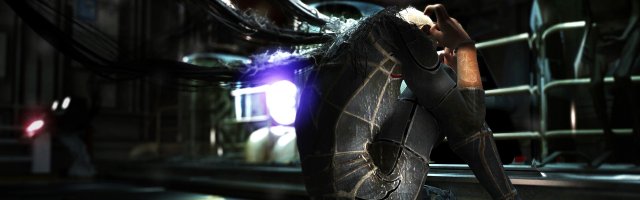
He picked the wrong day to give up smoking.
This is probably the happiest moment in the game for John, as things just don’t get any better from this point forward. As the story progresses, you will learn what the ship he is on is for, how he’s ended up on it, and what happens to his family. I won’t give spoilers, but none of them are good. Like the best tragedies, you’ll likely find yourself empathising with John’s desperate plight and rooting for him to recover from such insurmountable odds. The tremendously emotive voice-acting from Ryan Cooper really helps with this, as despite the low-budget nature of the game (it was the first full-length title by three-person developer The Brotherhood on release), he delivers everything with a genuine sense of purpose and motivation.
This Nintendo Switch re-release has been timed to coincide with the game’s tenth anniversary, and despite having the title on Steam for a number of years, I hadn’t got around to playing it before our review copy knocked on the door. One of the main reasons for this is that I wanted to put a fair bit of time into it, due to the screenshots making it seem like an isometrically-viewed RPG. I was expecting something like the original Fallout games or Baldur’s Gate. Actually, this isn’t the case at all. In fact, STASIS is a point-and-click adventure with that familiar perspective.
It’s rare to see this type of art in this genre, so it gives it a different feel from a lot of its peers. It does make it a little bit more difficult to work out exactly what you should be focusing on at a few points, and the size of the Switch’s screen in handheld mode doesn’t help this, so it’s better played on a big screen. Even then, though, I found there were more than a couple of “hunt the pixel” type situations where the solution to a puzzle turned out to be an overlooked item in a dark corner of an earlier room. There’s no kind of “yellow paint” mechanic to make this any easier, so I have to confess that it was necessary to look up some of the puzzles along the way.

I'm sure this will be a lovely holiday.
If hard-to-find items are one of the cardinal sins of a point-and-click, then it’s probably second to the old “moon logic” trope, where the combination of objects required does n’t make sense even when you know what they are. Thankfully, most of the puzzles in the game are reasonably sensible, but there were more than a couple of moments in which I found myself rubbing all the items in my inventory together until I found the right answer. The good thing, however, is that you’re never in possession of more than four or five items at a time, so in the uncommon event of a non-intuitive puzzle, there aren’t too many combinations you need to try before you stumble upon the right answer.
Whilst it’s not perfect from a mechanics point of view, the pacing and progression feel just perfect, and more than makes up for a few minor foibles. You really get a sense of the despair and isolation throughout STASIS. There are only three characters, who are communicating through radio instead of being with each other anyway. Your main source of information about the world is found on PDAs scattered throughout, very much akin to how we learned about the history of Rapture in Bioshock. Just like in that game, you often already know the fate of the poor sods who recorded events due to finding the PDA on their mangled corpse (or in some cases, bits of it). It’s a nice technique as even before you start reading what is essentially their diary, the impending doom is glaringly apparent.
If you like a good psychological horror, and you can forgive some unintentional hidden-object style moments, this is likely to be right up your alley. It’s a gripping tale of an underdog doing their best in a dire situation, and everyone loves an underdog, right?

The art style helps convey the dark and brooding nature of the game.
STASIS (Reviewed on Nintendo Switch)
This game is great, with minimal or no negatives.
A gloriously depressing psychological horror tale, conveyed with the visual style of Fallout and the mechanics of Monkey Island.

GameGrin are proud to have all their articles researched, written, and edited by real people that care about gaming.


COMMENTS