
Tainted Grail: Fall of Avalon Review
The first person fantasy RPG genre has been dominated by a certain bundle of geriatric vellum, so seeing another title throwing their hat in the ring is both a surprise and a pleasure, even if dethroning the Elder Scrolls can be a monumental task. Questline’s latest attempt, Tainted Grail: Fall of Avalon, starts off with an interesting first step by setting its game in the odd world of Arthurian legend. I hope we never visit Caerbannog, though.
Based on the board game of the same name and set in the titular land of Avalon, Tainted Grail takes place decades after King Arthur led his people from the Homeland to escape both a plague epidemic called the Red Death and an ethereal, cosmic force known only as the Wyrdness. The custom-created player character finds themselves in a hospital — or prison, depending on who you ask — being experimented on by the Red Priest, practitioners obsessed with curing the deadly malady, for unknown reasons. Riddled with the disease, we seem to be at our life's end. However, a hooded stranger unlocks our cell, and our escape begins.

Through a series of conflicts, labyrinthine corridors, and more questions than answers, our plague-bearing hero finds themselves entering a portal and appearing in another world. Visions of a bloody ritual flash as we hear a deep voice ask for help. Reaching the origin of the voice, we end up meeting — and absorbing a part of — the King of Kings himself, King Arthur. Newly cured of the plague, we find ourselves washing up near the Horn of the South, tasked with gathering the other shards of Arty while also figuring out what is going on.
I adored this opening and the setting in general. Tainted Grail does a good job of giving the player enough to get going, but leaves most of the “rules” of the land ambiguous. There is magic, but the Druids were culled years ago. The Wyrdness is deadly, especially at night, but can be kept at bay with a fire. It's a lovely mix of folklore and “history” that I wasn't expecting! The game also has a dark sense of humour that shines through the dark facade, which I found fascinating. I think the moment I was sold on the game was when an NPC noted how the attempted resurrection of Arthur was nothing new; in fact, they do it every time something big and bad happens, which I found hilarious.

Suppose you've played the aforementioned ancient parchments. In that case, you'll be very comfortable with the basic mechanics: controlled primarily from the first person, you explore locations, fight monsters and baddies apace, complete quests, and loot anything and everything not nailed down until you're overencumbered and regretting your build.
In terms of equipment, you have the basic setup of armour slots for your varying body parts, and two hands to fill with weapons, shields, wands, and other accoutrements. Interestingly, the game seemingly eschews the traditional system of labelling armour into categories such as Light or Heavy, but instead determines your average level based on the weight of your worn gear. Speaking of breaking tradition, Tainted Grail also utilises a somewhat different approach to attributes and skills.

Your stats are divided into six main categories: Strength, Dexterity, and Endurance for physical prowess, hardiness, and alacrity; Spirituality, Perception, and Practicality for the mental side of things. In addition to these six, you also have numerous stats that will slowly increase in level as you use them.
Skills themselves are tied to the aforementioned stats, so something like swinging a single- or two-handed blade would be under Strength, whereas bartering with a merchant is found under Practicality. Though you are asked a few questions at the beginning of the game to get your starting items and skills, you're free to invest your points as you see fit. If you decide your current build is unsatisfactory, you can find special potions that will reset and reimburse all of your points.

Moving on to combat… it's fine. Most of it boils down to swinging your weapon of choice vaguely in the direction of the nasty things and hoping for the best, as is par for the course. You do have a dodge ability, which adds a level of strategy to conflict, but it can be a bit on the repetitive side, all in all. I will note, however, that the game does a good job of handling dual-wielding weapons, incorporating both weapons in a basic attack automatically, and there is an attempt to step away from the shield-centric fighting you often see when someone vows off of sneaky archery.
The enemy AI is regrettably on the simple side, with enemies being befuddled by slight elevation changes, losing interest in you suddenly and going back to their original spots, and being unable to hit a stationary target. It's not a major issue, as the combat is not exactly elegant, but it can be frustrating to have your quarry run off and fully recover moments before victory.

As in many open-world games, the map is dotted with points of interest to discover, caves to spelunk, and overpowered enemies to run into. However, Tainted Grail is actually more of an open-area title, as the story is split between three explorable areas. I prefer this approach, as it makes it much easier to craft a more coherent whole and allows exploration without feeling overabundant.
You can also run into quests and tasks to do for the many residents of the lands. These can be very basic things, like slaying a few bandit chiefs or finding out why the cemetery's occupancy is lessening daily, but you can also find a few pretty strange encounters. For example, a quest had me find the entrance to a long-forgotten crypt, blow open its entrance, and locate whatever treasures were inside.

Upon doing the first few steps, I found myself face to face with a man wearing a chef's hat and raving about sour cream and herring. Following the quest to its end, I had learned a recipe for said meal and learned a spell that turns people into cheese. The humour of this game is both amazing and perplexing.
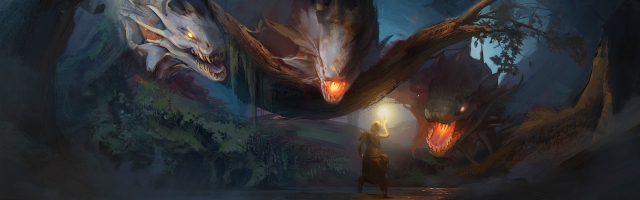
The best thing about Tainted Grail is definitely the atmosphere. The world itself seems dangerous and foreboding, with the constant decline of the land clear to see. Caves and crypts are properly dark, bandits crowd around old walls and ruins, and monsters prowl everywhere beyond the light of a fire. The absolute peak of this immersion, however, is during the night, when the Wyrdness comes.

As the evening slowly turns darker, the general ambience of the game goes from your usual fantasy medleys to a low drone, a fog rolls in, and things get, well, weird. For example, humanoid enemies you face will be overtaken by the miasmic force, becoming stronger, fiercer, and faster. You may also run into unique encounters in the mists, though it's hard to say if they're real or not. Finally, you are seemingly hunted by a crystalline golem that pops in and out of your periphery.
Now, one may wonder why you'd ever go out into these mists, as even the locals advise against it wholeheartedly. Firstly, Wyrdness-infused foes may drop unidentified loot that can be quite valuable. Secondly, slaying these monsters is one of the only ways to obtain Ethereal Cobwebs, a mercurial resource used to fuel your bonfires in order to unlock advanced features, such as fast-travel.

Bonfires themselves are a great mechanic: available to be deployed at any time, as long as the surface is level enough, you can use your ad hoc campsite to level up, cook food, brew potions, and talk with the disembodied ghost of the great King of Kings himself… assuming there's something he want a to chat about.
While the bonfire itself is free to throw down, unlocking any of its more useful features, such as identifying items, requires using the aforementioned Cobwebs, making it a tactical choice. Additionally, the bonfire creates a visible barrier of protection against the evil forces out and about, which is a nice touch.

Though the land and its ambience are very good, I was surprised to find that the characters were even better, at least some of them. The NPCs can be mean, vindictive bastards, as is fitting for the dark fantasy setting, but there's a lot of humour and genuine moments to be found too. A frazzled guard may be honestly concerned with the disrepair of the village, whereas the ancient druid ritual you were tasked with figuring out may wind up being a complex prank. And then there's the cheese spell.
I also enjoyed King Arthur's character quite a bit. What starts out as a somewhat bland story of a noble in the midst of peasants quickly turns into Arty's honest introspection and worry about how the world views him in a negative light. The guy is very wholesome, though I have little doubt things will turn very Ides of March-esque later on.

Now, I've sung the game's praises quite a bit so far, but I did have a few issues, some more critical than others. On the minor end of things, the game has a habit of stuttering a bit when you use the spyglass, and defeated enemies often show off their breakdancing moves on the ground. I've yet to completely lock myself out of a quest, though I have often had the feeling I've sequence-broken myself past some sections.
On the more critical end of issues, my time playing on the PlayStation 5 had at least one complete crash per session. Sure, the autosave had my back most times, but losing progress was still a pain. The crashes were so bad, in fact, that I had maybe one or two gaming sessions where I was the one deciding to voluntarily put the controller down, instead of having the game crash and my patience run out. I managed to lock myself out of a few quests as well by simply choosing the wrong dialogue option and being unable to complete or even fail the task. Yes, it’s prevalent in the genre, but it’s 2025; this shouldn’t happen.

Adding on to the issues, Tainted Grail had a penchant for innovating in one area while fumbling in another. You have four quick slots for weapons, so you can easily switch between melee and ranged gear, for example. However, the sheer amount of weapon combinations and spells quickly left me wishing for more slots. In the same vein, equipping any weapon from your inventory would also override your current quick slot, forcing you to re-equip your previous items.
Visually, the game is great. Yes, it's very dark, bloody, and edgy, but there's also a sense of humour and underlying wonder. This same combination of ew and awe is very apparent in the land itself as well, with ruined grand structures and beautiful vistas balanced by squalor and dirt. Your armour and gear are equally distributed between rusty bits of metal to mystical wooden implements of power. There's also some great attention to detail and environmental storytelling, though it varies heavily based on the location.

The sound design is adequate. The main theme of the game is fittingly haunting and alien, whereas the ambient soundscapes are usually for the current location and mood, though I'd be hard-pressed to recognise any individual tracks. Similarly, the sound of weapons clanging and smacking into flesh is done well.
In terms of voice acting, the performances are hit and miss. The main cast is stellar, with Arthur’s deep baritone being a personal favourite, but some side characters can be wooden. Though there are more variations in lines and voices than in some exemplars, you will be hearing the same three taunts from human enemies to no end, regardless of your foe being a deposed noble or a disillusioned farmhand. I’m pretty sure they have the same faces as well. Tainted Grail does, however, deserve credit for using Irish, Scots Gaelic, or both in dialogue (my proficiency with both is very low). As these were the “ancient language” of the time, it is fitting! Additionally, both tongues are very rare in modern Britain, so I appreciate the use.
To summarise my thoughts, Tainted Grail: Fall of Avalon is a mix of great ideas, stellar ambience, and a heap of jank. I enjoyed my time with the game and found myself coming back to it, but it felt like every fresh innovation was paired with a niggle or annoyance to match, making it average out to a “just okay” experience. It stands up, if not surpasses, its peers in many areas, but it also needs work in terms of stability and smoothness. I want to like the game more; however, the small bugs, the crashes, and the simple AI left me wanting more. In conclusion: a good title, which could be great with some polish, but leaves you wanting as is, at least on consoles.
Tainted Grail: The Fall of Avalon (Reviewed on PlayStation 5)
This game is good, with a few negatives.
Tainted Grail: Fall of Avalon is an immersive and dark fantasy adventure with great characters and ambience. Though it has issues with stability, it’s definitely worth a look for anyone interested in the genre or Arthurian myth.




COMMENTS