
The Drifter Review
After spending hours in the 2D, action-filled world of The Drifter, I’ve heard Mick Carter describe death in what feels like a million ways: reality breaking, icy tentacles, a terrible light. This pulp thriller crafted by Dave Lloyd and Powerhoof has no shortage of grisly, brutal killings, but they never mean “Game Over”. No, that’s our protagonist’s blessing and curse; when Mick dies, he comes back, giving you boundless chances to point-and-click your way to survival, whether you’re crafting makeshift tools, planning the perfect escape, or standing your ground against terrifying monsters. The problem is, every trip to the other side etches into his memory (pain included), and his sanity hangs by a thread.
Figuring out the why and how behind Mick’s death-defying ability is only one of your objectives across this suspenseful, twisting tale. Carter’s long-shelved return home after half a decade was probably never going to be a rose-coloured affair, especially since it’s a funeral that called him back, but I’m sure he didn’t anticipate a visit teeming with conspiracies, kidnappings, and dead bodies. It quickly becomes clear that something sinister is going on in his hometown, something that feels much larger than Mick’s internal struggles. From the moment we press play, our titular drifter becomes a pulp hero with big problems.

I fully believe The Drifter is best played like a beach read, with one hand flipping through — or in this case, clicking through — the action and the other hand holding your drink of choice while you absorb the gripping adventure. Everything from walking to talking can be done with your mouse, and your cursor changes symbols whenever you hover over something interactable. As you progress through each of the nine chapters, you’ll investigate gritty locations and escape from tricky situations, all of which will require you to simply click on items to observe, talk about, or add them to your inventory. Combining items is easy, too, as you can select one and drag it to the object you want it to merge with. That said, if you prefer playing with a controller, that’s also a simple and enjoyable option, as the controls remain uncomplicated when doing everything I mentioned above.
Puzzle solving will move you through the story in two ways, allowing you to uncover more information that opens up new locations or helping you survive a dangerous encounter. Whether you’re trying to play a cassette tape or break into a cemetery’s office, the solutions always feel satisfying and aligned with how Mick would handle a challenge. For example, you may want to cut to the chase and stab someone with a knife, but Mick will calmly narrate that he doesn’t want to resort to violence without reason, even if he does agree that it’d feel good.

I also loved getting to travel through multiple locations in later chapters, finding answers to puzzles threaded amongst the items and characters in different spaces. As such, every area felt utilised to its fullest — no nook or cranny wasted. I highly recommend revisiting places and talking to characters again if you ever feel stuck, as something (or someone) new might appear.
It might seem odd to combine fast-paced action with point-and-click puzzles in the same sentence, but that’s how many sequences play out in The Drifter. When faced with a life-or-death situation, such as a monster walking toward Mick, you need to get him out before it’s too late.

There’s no timer counting down in the corner, but each time you interact with something, it counts as time passing. I often interacted with many objects, getting Mick killed because I used up too much time. So, you do need to use the correct items in a limited number of choices/moves. That said, there’s no time pressure as long as you’re not interacting with the environment; you can think and plan out your steps even when the danger feels urgent. These high-intensity sequences were often my favourite parts of The Drifter. Solving their puzzles felt like learning the precise steps to a dance, and the “aha!” moments were quite enjoyable.
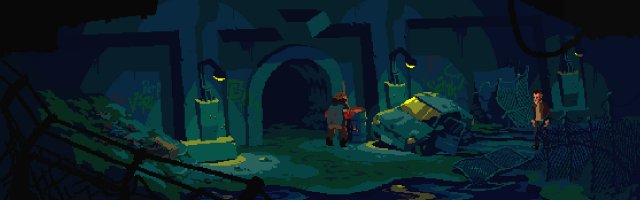
Mick Carter’s moody world is built on chunky pixel art and noir atmosphere. If you like murky, gritty settings, you’ll find much of that here, but there are enough areas that flip the grey, moody colour palette for warm hues, and at other times, cold sci-fi aesthetics. Each area is unique, memorable, and easy to navigate. The dark-synth music always fits the vibe, as well, giving you a cohesive visual and auditory experience.

As for story and characters, this is the opposite of a slice-of-life tale. We’ve got thrilling action and a cast that could’ve been plucked from a mystery novel; that said, they feel tropey in a way that makes them familiar, not unoriginal. Whether you’re talking to the hard-boiled detective or intrepid journalist, the dialogue is distinct, engaging, and voice-acted exceptionally well. Particularly, Mick’s dialogue — spoken or narrated — offers so many layers to his character, from his deeply-held regrets to his on-the-spot wit. The use of the present tense also keeps the writing fast and urgent, complementing action-packed moments.
I loved the flair baked into descriptions of the world around Mick, as you get a good grasp of what he sees and how he’s feeling through the screen. In The Drifter, we’ve got an “avalanche” of noises, screams turning into “ragged bleats,” the “violent buzz” of lights, and more. For a story with tight pacing, it shouldn’t be a surprise that every word provides a punch of description. I might sound like a broken record when I say nothing goes wasted, but it’s true, every word in this game is going to give you the most detail and/or emotion that it can elicit.

This writing style came in handy when, in action-packed moments, the screen would fade to black and Mick would describe what he or other characters were doing. I couldn’t tell if this was simply a stylistic choice or a way to avoid animating some rather complicated sequences, but nonetheless, the darkness did leave me wanting. You won’t be wondering what happened, thankfully, but you might be wishing you got to see it yourself rather than imagining it.
The Drifter’s quick pacing from chapter to chapter keeps every moment entertaining and mysterious, packed with drama, humour, and danger. I was quite sad when it all ended, as I wanted to solve more puzzles and continue getting into tough situations with Mick. That said, the nine chapters do feel complete, and as I’ve noted, this is a tightly-crafted experience with no wasted space in either the gameplay or storytelling.

If The Drifter were a book, there’s no way I’d stop turning pages. If you like delightfully tropey characters, chunky pixel art, puzzles that aren’t too obtuse, and excellent voice acting, then I fully recommend giving it a go. It’s enjoyable, engaging, and accessible for those who love and those who are new to the point-and-click genre.
The Drifter (Reviewed on Windows)
Excellent. Look out for this one.
The Drifter is a well-written, fast-paced point-and-click thriller that will keep you glued to your seat. It’s a must-play for those who love puzzlers, mystery, and adventure.



COMMENTS