
The Knightling Review
When you enjoy the hobby of gaming for long enough, you're bound to run into a title that takes you back to your early favourites. I haven't had that Ratatouille childhood flashback in ages, but it has struck yet again in the wholesome wonder that is The Knightling.
The plot is, at first glance, simple: you step into the sabatons of a soldier-in-training known as a knightling. Your teacher, however, is the legendary Sir Lionstone, a renowned warrior who bested the ancient enemy of your home, the gigantic stone creatures known as the Earthborn. Your armoured idol gained a sword and shield from this bout, which contained a magical substance, known as Chiralium, that both gave him substantial strength, while also beginning the land’s obsession with said mineral.

You and Sir Lionstone set off on a mission to look into some disturbances near your home, going through the mechanics and basic movements as you go. A minor task turns deadly as you happen upon a sealed vault filled with Callyrium weapons and its deadly Earthborn guardian. Lionstone fights ferociously and even flings his shield to save you from a mortal blow! However, he and the foe quickly disappear down into a canyon, leaving only the shield and his gauntlet behind.
Dragging the now-broken equipment back to town, you report the dire news to the Queen, while also wondering what will happen to you now. The Queen, however, is much more interested in the vault rather than your chivalric mentor, so you're basically left to your own devices. Happily, your blacksmith's apprentice friend, Gynni, manages to restore the shield, Magnustego, to working condition, and you quickly realise you can wield it easily with the gauntlets, being able to throw the shield long distances and call it back to your side. Armed with your new gear, you set off to find word of Sir Lionstone, while also doing your knightly duties of helping the people and taking out any dangers you find.

The Knightling is all about adventure, which is mirrored in its open-world design. You’ll start out in the Outskirts, but can slowly make your way to new locations as you progress without having to worry about loading screens, unless you decide to quick-travel, of course. Each area is visually distinct, with the first zone brimming with life and colour, whereas the later locales show the signs of corruption and battle; life beyond the knight's protection is dangerous, after all.
The game has no minimap, only showing points of interest or quest markers on a compass-esque indicator at the top of the screen. I say “esque”, as it doesn’t actually show you the cardinal directions. The poor Knightling doesn’t even have a map! Luckily, the local cartographers' guild is happy to help out, as long as you clamber up to their watchtowers and lower the ladder. Upon completion, the guild will provide you with a map of the nearby area, in addition to selling Stamps, which will show the locations of points of interest, such as chests and ruins, but will also show you how many of each there are to find in the area!

Exploration is rewarded in multiple ways, be it with hidden chests, challenging bandit camps, gathering money or scrap, or by simply collecting the shiny yellow orbs strewn throughout most locations. These shiny baubles are known as Praise and act as your experience, of sorts. Gather enough and you can spend it to learn new moves or power up existing ones. In addition to being found floating about, completing quests is another great source of Praise… while also being generally a fun time.
My absolute favourite thing about The Knighlting, however, is the movement. Our hero is not exactly broad or muscular, but makes up for it in spades in dexterity, as you hop, roll, dodge, and slide your way across the fields. It feels exceptionally fun to clamber and climb through the hills of Clesseia, and it seems you always have an easy way to get up or down, depending on the location.
Best of all, you can even hop onto your shield and use it to surf your way around, which is both surprisingly fast and ridiculously fun. The ease with which you can switch from running to sliding to gliding is seamless, and allows for a lot of creative platforming. I have the feeling this is going to be an amazing game to speedrun. This protection-based skateboarding is what had me putting on my rose-tinted goggles, as it feels very similar to the hoverboard in Jak 2

In addition to treasure and shenanigans, you can also find yourself contending with a puzzle or three during your daring quests: these often take the form of using pressure plates and beams of Callyrium to form a specific image, but you may also have to perform some timed platforming or find the optimal route in a maze. While the puzzles themselves can be a bit samey, there is enough variety to not make it annoying. A fair few brain-teasers are also completely optional, so you can safely leave them for when the mood takes you, rather than struggle through.
Now, not everyone is as kind as our hero, and as such, you will find yourself having to defend yourself or others from both bandits and beasties. As one may expect, a shield is not the most optimal of weapons for offence, and the same is true here. While you can swing Magnus around and damage enemies, it is much more efficient to block, parry, and dodge your way to victory.

Enemies have a metre, which will slowly fill up as you attack them. Once full, they will be dazed and will take increased damage, allowing for a quick takedown and taking one threat out of action temporarily. By using special attacks performed after a block, or timing it right and getting a parry, the metre will fill much quicker, which incentivises you to think defensively rather than going in shield swinging.
However, the game quickly mixes things up by adding different enemy types, ranging from the everyday common foes to quick fighters that can avoid your blows, and armoured fighters that need to be dazed before you can rip off their protective shells. The different kinds of baddies are helpfully easy to identify, as their health bar has a coloured border matching the type. While this may seem unnecessary, you take on larger gangs often enough for it to be a lifesaver!
In general, the combat is serviceable and even fun! However, it’s not the focus of the game, and it shows. While you can add new moves to your arsenal, it often boils down to a game of blocking and parrying with the occasional attack and dodge thrown in. This isn’t a bad thing, however, as the combat is as complex as it needs to be to act as a facet of the exploration.

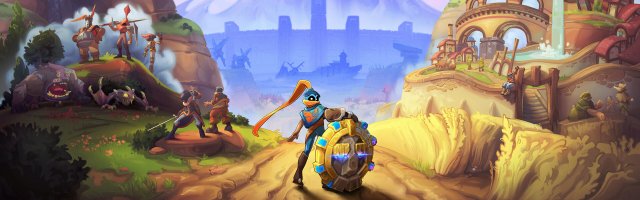
Visually, The Knightling is beautiful. Featuring an almost storybook-esque aesthetic, the land is vibrant with colour, be it green fields, brown canyons, or the dark and foreboding stone of ancient ruins. The game also does a fantastic job of making useful and interesting things pop out by using contrasting colours or distinct shapes. Bouncy mushrooms are a vivid purple, whereas the bright yellow Praise orbs are easy to spot. The enemies themselves make great use of silhouettes to define what kind of enemy you are facing, with broad brawlers lumbering towards you as thin, speedy swordsmen dart in and out.
The people of the world are also a great study in design, as they are required by law to wear masks. For knights, this is easy enough, as the helmet does the job, but the way The Knighlting tells a story all its own by the types of masks NPCs use is pretty ingenious. For example, the nobles of the land may have expensive hoods of silk, a woodcutter may wear a log, and the royal knights favour cymbals to announce their presence, whereas the downtrodden and poor may have paper bags or even wooden boxes. It’s a great visual and adds a lot of charm to the game. I also like how the villagers themselves may comment on the different masks and how silly it is to use them.

The sound design is equally good. It’s calm and ambient during your explorations and quickly switches to a more upbeat and exciting track when you enter combat. Honestly, I have a hard time pinning down any one track, as it does a great job of melding into the background. The game also has voice acting, but it’s mostly vague jibber-dialogue. Everyone is wearing masks, after all, so it makes sense for speech to be muffled, right?
The largest exception to this is your trusty shield, Magnustego. After a bit of adventuring, upgrades, and fixes, your staunch protector does start talking to you, which is an interesting addition. Once he gets to chatting, he will thenceforth comment on quite a few situations, such as your current location, the presence of bandits, or how the dirt hurts his nose as you slide. The voice acting is quite good, and he does have a few funny lines, but I do fear his notions may wind up being a bit repetitive in the long run. His snarky attitude can also be a bit stinging, as he sighs dramatically after your defeat. But in general, his comments are fun without overstaying his welcome.
Looking at performance, I had very few issues during gameplay. When racing down a hill or taking on a few too many bandits, there may have been the odd stutter or two, but nothing major. These issues were a bit more prevalent on the Steam Deck, resulting in a bit of GPU lag and general slowdown, but again, nothing serious enough to mar the experience.

However, there are a few weird design choices I’m not sure I agree with. First off, there is no “continue” button on the main menu. Your cursor starts off on the “New Game” option, and you’ll need to go down to load a save. This sounds like a small thing, but it does get annoying with time, as it’s pretty common for me to just select the first option on instinct.
In a similar vein, the game is also a bit confusing when it comes to checkpoints. When you are defeated, the screen fades to black and you’ll find yourself in an earlier location. So far, so standard. The problem is, it is not always clear if this was the game loading the latest save, or if you’re simply being brought back further away from baddies. This is important, as the autosaves are sparse enough for you to have found a chest or two, or collected some resources before heading to your fatal encounter. If you’re loaded into an earlier state without realising, you may forget to go get the aforementioned resources and barrel on back to the fight.

Finally, the map markers can be a bit confusing, as they will not always be marked as done, even though you feel like you’ve explored the area. It’s clear that it means there's more to do, but it can be frustrating, as the game gives little insight on what each location considers a requirement for completion.
It should be noted: these are all small problems that will probably disappear after a patch or two. However, in its current state, they do bother me enough to be noticeable.
Minor, fixable flaws notwithstanding, The Knightling is a beautiful and fun game. Running around and exploring hasn’t felt this fun in ages and the memorable characters, humour, and underlying mystery keep you hooked as you slide across the countryside. It feels like a love letter to the adventure platformers of the sixth-generation of consoles, and is a great title to simply pick up and play after a long day. If nothing else, I am looking forward to the speedruns.
The Knightling (Reviewed on Windows)
This game is great, with minimal or no negatives.
The Knightling is a wholesome and beautiful action platformer that hearkens back to the PlayStation 2 era. Great humour, amazing movement controls, and fun combat make this a title you won’t want to miss, though there is still room for a few QoL updates and patches.




COMMENTS