
The Royal Writ Review
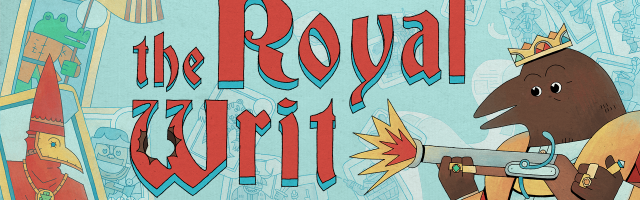
Once upon a time, there was a game called The Royal Writ. It was developed by Save Sloth Studios, which you may know for A Most Extraordinary Gnome, but is also published by Yogscast Games, who you may know for a whole lot more. An interesting art style that evokes children’s books with deckbuilding and roguelike gameplay, I was at least interested when I came across it, so it's time to give it a fair shot.

Our tale truly begins within a great kingdom named Aranfold, ruled by the admirable, loved, yet slightly strict, King Mikolt the Second. Together with his loyal Chort Council, the kingdom thrived under their rule. However, one day, one of the council members suggested doing something about the bandit leader Robert Horka, who is causing trouble around the lands for far too long. And so, he writes a letter and sends a small army to deliver it to convince the bandit to meet with him… or rather, burn all his bandit camps to the ground and have the guy beheaded or something. And so begins one of several campaigns of writing letters and sending armies to violently deliver them to their leaders.
However, that's only Act One. Act Two involves, um… the “loyal” Council overthrowing the king and then making everyone miserable with their tyrannical rule. But not all hope is lost, Mikolt isn’t backing down without a fight and leading a rebellion to retake his throne using an experimental weapon: a gun! Both are perfectly serviceable stories that don’t get in the way of the gameplay. It’s fine and this is the type of game not to be too focused on it.

Although, I have to say I really loved the little animations included, such as the backgrounds for battles, the little cutscene for beating bosses, and even how cards shake when they're being sacrificed or about to die (which is actually a gameplay mechanic). It didn't really have to go that far with all these cute little moments of life and whimsy, but it is much appreciated.
Act One and Act Two play somewhat differently from one another, having exclusive mechanics and cards between them, but they have the same basic game. In order to win, all you need to do is beat all the bosses that each area has. In battle, you’ll be placing down units to attack the enemy, using the Letter cards you get with every turn to buff and modify your soldiers, and get the enemy's HP to zero before you run out of cards.

Between fights, you’ll be refining your army by adding soldiers, collecting relics with passive buffs, and maybe sacrificing your dudes for better stuff. Hey, they’re the ones willingly letting me trade their teeth for relics. You can also upgrade your field to have bridge spaces for more power, turn the column modifiers from plus numbers to multipliers, or simply increase your deck limit.
With the right combination of power bonuses, multipliers, and beneficial effects, you can deal thousands of points of damage in one turn, which is really satisfying to pull off. However, this can go horribly wrong, as your numbers can go into the negatives, which actually heals the opponent instead of dealing damage. And no, two negative numbers don’t make a positive! If you don't want to attack, you can always have your units choose to walk instead. They’ll deal no damage, but at least they might not end up making your opponent’s HP over its limit.

And if that’s not enough trouble, there is a great risk in sending out every unit you have in hand: Anything that happens to them is permanent. That means any ailment will persist between fights, and bonuses they gain remain unless specified, and if they are killed (either by losing all their power or reaching the end of their row), they stay dead and are taken out of your deck. You start off with three cards and a maximum of seven to make up your deck, so getting your economy going is really important. While you can ignore the deck size limit, newer cards will be inflicted with ailments which can cripple that unit… or with the right relics and cards, benefit from them. Either way, if you lose all your playable cards, it's a game over and you’ll need to start back from scratch.
But that’s only how Act One goes. Act Two, as I mentioned, plays a little differently, as for starters, you’ll be dealing with projectiles in this part: bullets, thrown pots, poisoned knives, exploding bullets, and a whole lot of other things to make your rebellion whimper. They go across the lanes at the end of your turn and if it gets to the Start row, you lose Morale, which is your health in this mode. At 10 or below Morale, your column modifiers are reduced to +1, so it's best to have people who can take a hit. You can also change the lane so that they duck under the projectile, keeping them safe in exchange for Morale. You also have access to Spy cards, which have a variety of useful effects, but are on a global timer, so you won't be getting them constantly. It’s a serious shift in gameplay, turning it more like a traditional roguelike without changing many of the mechanics. It is definitely harder to deal with, but it is a refreshing challenge if you’ve conquered Act One.

That being said, I think my biggest problem with the gameplay is just all the sudden ways your runs can die, which is sometimes out of your control. It’s more than losing a powerful soldier: some of the bosses just screw you over before you can even react, such as when I faced an opponent who had the ability to add the Educated ability to all my cards. Educated makes it so that the card’s base power is multiplied by -1. This also happened with an Opportunity event that warned me not to get freaked out. Safe to say, those runs ended very prematurely. Urgh… it’s one thing to lose because you haven’t built your deck well enough to overcome a challenge; it’s another to completely lose it all from a backstab.
However, with every loss, there is still some progress to be made. By beating a Rescue encounter or by fulfilling certain conditions, you’ll unlock new units and relics. They become available during a run and you can find them in the future, so simply playing the game is encouraged. There is quite a bit of replayability, too, as once you do win a run, you’ll unlock Challenges (play a run with special rules) and Hardships (stacking modifiers guaranteed to make your attempt harder to win) to really test your abilities on.

While frustrating at several times, The Royal Writ is a good roguelike to cut your teeth on. It emphasises planning ahead and keeping yourself focused in order to win the game. It can throw curveballs at you that will kill your run, but the satisfaction of creating a mighty army that synergises with one another to deal thousands of points of damage is great enough to lighten the blow.
The Royal Writ (Reviewed on Windows)
This game is good, with a few negatives.
The Royal Writ is a good roguelike that emphasises planning ahead, taking calculated risks, and rolling with the punches. However, at times, it can unfairly kill your run before you can even react to it.




COMMENTS
Hortus - 04:35pm, 12th August 2025
Just an FYI, -1 x -1 = 1.
Education isn't a run ender ;-)