
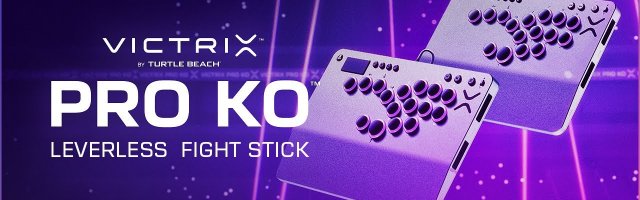
Victrix Pro KO Review
Earlier this year, I picked up the Victrix Pro KO leverless controller. For the uninitiated, these are controllers designed for fighting games, similar to fightsticks, but opting for a series of directional buttons rather than a traditional stick.
I’ve tried a few of these in the past; first up, the Haute42 T13. This got me a nice feel for the layout, but had some issues. It was a little too small for my liking, and the buttons were wobbly. It was a generally cheaper feeling product, but for the price, I was more than happy. It’s a budget option, and it feels like one, but it’s a fantastic entry point.
A few months later, I figured it was time to upgrade. A local shop had a Razer Kitsune at a genuinely solid price, and then I seemed to black out, and woke up at home with a Kitsune on my lap… Curious. This was a clear step up from the HautePad; its general build quality felt fantastic, the buttons were nice and snappy, and I generally felt I performed better with the Kitsune.
I wasn’t quite out of the woods yet, though; I was a little unhappy with the number of buttons, as — primarily for Street Fighter 6 — I like to have a separate macro button for throws. I could survive without it, but my rank was clearly hurting… I wasn’t looking for another excuse to spend more money on things I didn’t really need.

I’d seen the Victrix Pro KO floating around online, from other articles and creators. Eventually, I’d decided that was where to go next, and after one popped up online at a fantastic price, my fingers did their usual magic, and a few days later, the Pro KO showed up at my door.
Now, why did I bother with the Pro KO specifically? To some extent, it’s just another Leverless controller, but there are a lot of interesting little quirks that make it stand out, and have left me far more impressed than my previous outings with the form factor.
The biggest thing for me initially is the modular button layout and its general options for customisation. Out of the box, it comes with the exact same layout as the Razer Kitsune, but turning the controller over, there are four sneaky little latches. Popping all of these open, you’re able to remove the magnetic top-plate, revealing the treasures that hide within.

Once open, its insides reveal a plethora of little treats from additional buttons, switches, and metallic covers. This is where the Pro KO makes its mark: its layout is completely adjustable, with space for additional buttons with four extra switches and caps, to fill the four empty slots (if you’re so inclined). It also comes with a little switch puller, which lets you remove both the button caps and the switches themselves (which are Cherry MX Speed Silvers).
This malleability allows basically anyone to customise its core layout to their preferences, with extra macros if necessary, and its use of hot-swappable keyboard switches gives near infinite options when it comes to the actual switch performance. There are some other options regarding the button caps, as they use standard 24mm and 30mm buttons, but I haven’t actually messed with this myself, so I can’t speak on how well they work. The stock option isn’t awful, but they do feel a tad cheap; they wobble a little, and they have weirdly high grip, making quick sliding motions surprisingly awkward. It’s not abysmal, but it’s definitely a noticeable issue.
The Pro KO also has a lot of the typical tournament settings and options, too, to make it completely compliant with the typical tournament regulations. It has a tournament switch, which locks all the system buttons, stopping players from accidentally pausing or causing any other issues. It also has SOCD cleaning, which, to put it in layman’s terms, stops players being able to hold otherwise impossible inputs at the same time. For example, a standard controller or a fightstick can’t hold both left and right, or up and down at the same time, but due to the build of leverless controllers, this is pretty easy. In this case, most leverless controllers read those inputs as a “neutral” input, as if nothing is being pressed at all.
This does come with its quirks, though, as there are some interesting techniques that can be performed by taking advantage of the way SOCD cleaning works. For example, in Tekken, Korean Backdashing — a difficult and very important piece of movement tech — is unbelievably easy.

It also opens up to some other potentially easier execution in other avenues too: I took a lot of time learning how to get consistent with electrics in Tekken — a frame-perfect input — on a controller and standard fightstick. Moving over to the leverless, however, this time was drastically reduced, and I had a far easier time getting consistent. This isn’t to say this controller style is unfair, though, as it struggles in other aspects, where other controllers can outperform it. It all comes down to preference in the end.
The value here is really important to mention too… It retails for £229.99 in the UK, which is absolutely on the higher end of the price range for these controllers. If you’re unsure about the form factor, I’d recommend a cheaper entry option — such as many of Haute42’s offerings — but the Victrix Pro KO is a wonderful option if you’re looking for a more versatile premium option.
As a whole, though, I am genuinely in love with this controller. It feels good to use, has some really interesting options, and its issues are minor and pretty easy to live with. I can’t see it being my final leverless, as my money-spending fingers are itching, but it’s a more than satisfactory place to rest for now…
Victrix Pro KO Review
A fantastic leverless controller, more than worth the premium.


COMMENTS