
Dispatch Episode 1 and Episode 2 Review in Progress
When an emergency strikes, who would you call? It’s peak spooky season right now, so naturally, you might start singing the Ghostbusters theme song, but the answer I’m looking for is SDN, the Superhero Dispatch Network in AdHoc Studio’s debut title: Dispatch.
I’ve been looking forward to this story-heavy, hero management game since its announcement, and my excitement only grew following last month’s hands-off preview; the quality animation and interesting dispatch gameplay already looked incredibly cool. I also had high hopes for the choices, relationships, and consequences to come, given that it was created by the writers and directors of Tales from the Borderlands and The Wolf Among Us. So far, I’ve found that Episode 1 and Episode 2 are a promising start!

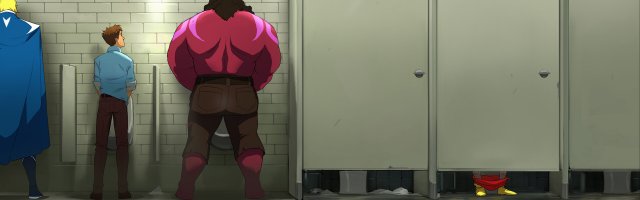
In a modern superhero-filled Los Angeles, the powerless hero Robert Robertson fights crime as Mecha Man, saving folks with his mech-suit rather than utilising extraordinary abilities. The opening of Episode 1 kicks off with the suit’s demise, though, as our protagonist’s shot at avenging his father’s death goes wrong. He has no choice but to pause his life of chasing supervillains, but that doesn’t mean he can’t use his years of hard-won experience to do good in the world. When given the chance to work at a superhero dispatch office, he takes it, especially since the company has promised to fix his suit in exchange.
While I won’t spoil everything that comes next in Episode 2, I will say we get to see plenty of chaotic first-day shenanigans that this office has to offer, from heartfelt reunions to heated arguments. If you already played the demo, you’ll see some familiar conversations and gameplay, too.

These first couple of episodes are a solid introduction to Robert, his past, and the new co-workers he’ll be dealing with at SDN. Each of the characters, even those with brief screentime, is memorable, funny, and already seems multi-dimensional; whether they’re interacting with each other or Robert, they’re entertaining yet real, never feeling like pixels on a screen. As for exposition, it’s all easily digestible, woven into scenes in ways that feel natural and seamless.
With such a stacked cast, from Aaron Paul to Laura Bailey, it’s no surprise that the voice acting is phenomenal. They deliver snark, jokes, embarrassment, frustration, and more convincingly, with each voice matching its character quite well. Not only has Dispatch set a high bar for vocal performances, but it’s also visually impressive, with smooth yet action-packed fight sequences, vibrant colour palettes, and expressive faces.

The primary focus of interactive fiction games is your dialogue choices/decisions and the different paths you take because of them. There’s nothing like the deep curiosity I get when “Everyone will remember that” pops up in the corner of my screen. There’s also nothing like that brief panic I get as the timer counts down while I’m deciding which of the three statements to say (yes, I’m indecisive).
For the first batch of episodes, I've noticed small callbacks to my choices or minor variations as I replayed to see different outcomes. Answering a question about Robert’s favourite doughnut flavour, for instance, does affect a scene later. At the moment, I’m still in the “I wonder where this is going” phase of the story, but I’m enjoying the options given thus far, as you can determine who your Robert is. Do you lash out when posed with a tough, insensitive question? Do you go in for a spontaneous kiss during a starry night? It’s up to you.

Dialogue isn’t your only avenue of interaction, as Dispatch features gameplay moments where you’re responding to calls from folks around LA, sending the right hero to their aid. Well, it’d be more accurate to call your team heroes-in-training, as they’re former supervillains looking to turn over a new leaf. Their skills were once used to facilitate crime, yes, but they can still be rerouted for good (at least, SDN hopes so).
Vigor, Mobility, Charisma, Intellect, and Combat are the five stats in Dispatch, determining how well a team member will match the needs of a call. When tasked with intercepting a convoy, retrieving stolen paintings, or helping out with a ribbon-cutting ceremony, you need to assess who will most likely succeed.

You do get rewards for assigning the right person to the right mission, with all outcomes being recorded. To improve your chances of a job well done, matters aren’t entirely out of your hands after sending off a hero. Sometimes you need to offer extra help by doing a simple hacking mini-game, unlocking paths or cameras. Other times, you can make additional decisions mid-call; for example, directing your teammate to get out quietly or go for a more aggressive approach.
It can be hectic, with multiple calls coming in at the same time and a timer counting down. I did miss one because my heroes who had the right stats were still resting after their missions, and I decided to chance it by waiting out their cooldown. I thought it might be worse to send someone in who clearly wasn’t a fit. You can get a hero injured by assigning them to a call they weren’t right for, at which point their stats decrease by one for that shift. A second injury sidelines them for the rest of the session, which isn’t great if a call pops up that they’d be perfect for. However, as I mentioned in our hands-off preview, heroes can’t get killed during a shift, only downed.

Of the 12 calls included in the first shift, I had nine successes, two failures, and one call missed. Not too bad, but not perfect! Even so, I still received a performance bonus, which yielded an extra random stat point to give a character. Since it’s still early in the game, I’m not sure how necessary it is to have perfect shifts or how vital these extra bonuses are in the long term. It currently seems like failures and missed calls aren’t heavily punished, at least at the moment.
So far, I’ve had two chances in Episodes 1 and 2 to take on distress calls, one being Robert’s assessment for the job and the other being his first shift, which was showcased in last month’s hands-off preview. I was hoping for more dispatching opportunities in the first couple of episodes, but what’s here is still quite fun. That said, I have some lingering concerns about the pacing, as these two episodes felt like they could’ve been bundled into one. My total playtime for both was 100 minutes on the first go-around.

Dispatch launches with its first episode batch on the 22nd of October 2025! Stay tuned for our future reviews, as we’ll cover each release over the next four weeks.




COMMENTS