
Translating DARK SOULS: A Chat With Ryan Morris
When it comes to laying praise on the Souls games, Hidetaka Miyazaki, understandably, crops up quite a lot. His unique creativity is the bread and butter of contemporary FromSoftware, and thus, he has, by proxy, helped to mould the videogames industry into what it is today.
With that said, however, FromSoftware's enormous projects require more than one man to produce, and as such, there are many unsung heroes, including the focus of this article: Frognation. Frognation is a Japanese to English localisation company, and its own Lead Translator, Ryan Morris, was kind enough to make time for an interview.
Born and bred in Seattle, Ryan was enamoured by the Japanese language at an early age. Not wanting to pursue anything else, he would soon improve his Japanese via higher education, before going on to settle down in Tokyo in 2001. For the 26 years since, Ryan has worked as a translator and had a hand in updating the language of anime, manga, and videogames for western audiences. He has even written a short play in Japanese, which will be performed next month in Tokyo at Space Aya.
Before jumping straight into the creative side of things, though, I still had a couple more questions regarding Frognation’s structure, wondering how a company such as this operated.

FromSoftware's games are huge, sprawling worlds, to say the least, and they, no doubt, require tons of writing work. How many staff members at Frognation work on them?
Ian Milton-Pulley and myself on the Souls games, plus a star editor. A very small, tight-knit, and long-running team. Someone please tell the corporate world that keeping a team together long-term can lead to immense gains in life satisfaction and sense of purpose and connection. I know it won't always be possible, but send out a memo or something.
How is the workload structured? Are you given a single block of work by FromSoftware during production, or is it more of a back-and-forth affair?
Hugely back-and-forth, as quality checks and accuracy are a focus. In the early days, I was all by myself with one editor each on the Japanese and British sides. The Japanese editor checked the input, and the British editor checked the final output.

Next, we got to talking about FromSoftware’s games more specifically.
What was the first FromSoftware game that you worked on?
Demon's Souls… the apostrophe wasn't my idea. I adore this game and have played through it many times. I fell in love with it (after it came out, not while translating it) and thoroughly enjoy playing Hidetaka Miyazaki's other games, too. My nephew and son also like them, which is a lot of fun.
So, I know that the team in Japan comes up with the characters, but how much creative sway are you allowed when fleshing them out in English?
We read a character description, then read the dialogue, and then we have to find a voice. We take the approach of trying to mirror the intention of Miyazaki and the effect of the Japanese, but this cannot be achieved by a literal translation. By definition, the task of translating from a language that is as far as Japanese is from English requires a lot of linguistic knowledge and creative or "writer's" ammunition. Our determination of the voices of these characters in English is by definition a creative task — finding their register and the finer points of their speech patterns — but it is entirely anchored by Miyazaki's baseline idea for the character and the exact language he puts on the page.
Adjacent to the previous question: how much freedom are you given when localising lore pieces like item descriptions?
It's the same exact process, but there is considerably less optionality when you remove the fact that these are not lines spoken by characters of varied backgrounds. I imagine them as historical records or writings of scribes and priests, and the tone and register are adjusted accordingly.
It's clear to hear that the voice acting is handled by British actors and actresses, and seemingly not other nationalities. Why is this approach taken?
Mostly British, yes. This is for a very specific yet completely arbitrary reason: British accents have become the standard for use in fantasy in order to evoke a feeling of being far in the past. This goes in the category of the "grammar" of fiction: things established over time that have become common practise, and as enculturated viewers, we share this grammar with the creators. For a small but not insignificant number of characters, we have also used Swedes, Finns, Indians, Africans, and even one lonely Canadian actor — Joseph May in the role of Ironeye in ELDEN RING NIGHTREIGN).

Ignoring the actual words spoken, the line deliveries feel very natural in these games, complete with pauses, stutters, and uneven cadences. And I love it! Nowadays, big-budget games typically have Americans speaking clearly and precisely (in a very movie-esque way), but why, creatively, is that not the case in FromSoftware's games?
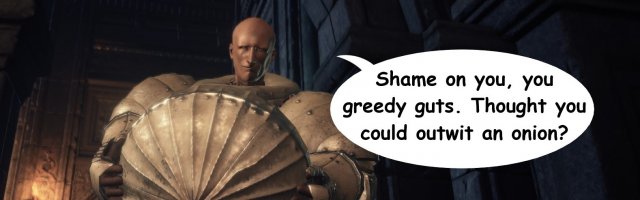
This is thanks to our wonderful and longtime voice director in London, Adam Chapman. He has never believed that videogames should be inhabited by people who speak more stylised or crisper or chipper or clearer than people in real life. I support the choice because I think it allows for more range — a sense of lived-in worlds and visceral drama. A good example of this being pushed to the extreme is Andy Gatherhood's performance of Laurentius of the Great Swamp in DARK SOULS. Okay, okay, maybe that was too extreme, but I absolutely loved it, and I've heard from some fans who strongly agree. None of this is to say that stylised performances do not have a place in the right game. I'm really glad that you enjoy my prose; the actors did a great job of bringing it to life!
The many inhabitants of these games more often than not come across as not altogether trustworthy, regardless of their intentions. Why are so many of the characters given this sinister, mysterious edge?
This, I honestly do not know the answer to because it is a Miyazaki thing, but it keeps me on edge when I play the games.
NPC dialogue always uses peculiar language; obscure or obsolete words and phrasing are a staple of FromSoftware's games. Why is this approach to dialogue the case?
This is to mirror Miyazaki's Japanese script, which can often be archaic and borderline cryptic.
Connected to the previous question: had you studied English history at all, and did that help when writing any characters?
I always loved writing and history, but after falling in love with Japanese, all my education was poured into Japanese literature, history, linguistics, and even the Japanese economy (that last one, despite levying the highest tuition cost, has not yet informed a single translation). Thank god Ian Milton-Pulley is the reincarnation of a Jacobean aristocrat.
And lastly, who is your favourite character from any FromSoftware title?
Solaire of Astora. Everything just fell into place there. The actor must have really understood something because we didn't explain it, and this is just how he interpreted the script on his own.

I would like to thank both Lynn Robson (of Frognation also) and Ryan Morris for their help on this one!

GameGrin are proud to have all their articles researched, written, and edited by real people that care about gaming.




COMMENTS