
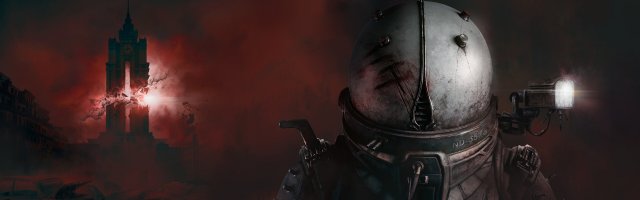
Cronos: The New Dawn Review
I haven’t been the most fond of Bloober Team’s past works: Layers of Fear didn’t land for me, I wasn’t fond of how The Medium handled certain themes, and the Silent Hill 2 remake, which I preferred over the other two, didn’t quite match the experience of the original. Cronos: The New Dawn looked different; I was far more interested in this project from an early stage, and I’d thought that maybe they’d release something more up my alley. It’s left me far more contemplative than anything else they’ve released, for better or worse…
Cronos puts you in the boots of The Traveller, a humanoid robot (I think) who serves under a strange Organisation called The Collective. You’re sent out to complete The Vocation, a task that will ideally result in you saving humanity from an apocalypse…one you’ll become incredibly familiar with. The game takes place within a post-war Poland, in a town called New Dawn, after a disease has broken out, transforming the populace into fleshy masses called Orphans, who’ll merge with their dead brethren, becoming stronger in the process. You’ll be tasked with travelling across both time and space to find crucial people to save humanity.

The premise is solid, if a little bland, but the general world design is great. The town of New Dawn is a brutalist nightmare, draped in a wonderfully melancholic fog, and all this would contribute to creating a well-realised world, but the problem comes in the level design.
Linearity is the bane of New Dawn; its exploration adds little to the world, and optional areas are always blocked behind arbitrary gating mechanics, such as requiring bolt cutters (which take up limited inventory space) or spending resources to burn away biomass. It almost kills the immersion, but I was so enamoured with the art direction that I could look past it.
The gameplay itself is really where I fell out of love with Cronos, though. It’s not criminally bad, but it committed an arguably worse sin in my mind — it’s boring. It’s a pretty standard survival horror romp, but its core systems feel oftentimes less engaging than its contemporaries from even two decades ago.
You’ll primarily be facing Orphans: horrible masses of flesh which can merge with dead Orphans and get stronger, developing new abilities. You find many of them have special features, such as armour or the ability to spit acid. Once these die, they can be merged with, giving those properties to the Orphan that merged with it. There are, unfortunately, not that many unique abilities, and none of them are even that dangerous, so it leads to a lot of monotony in the enemy encounters.

They also often prioritise merging over active combat, and they’re left completely vulnerable while in the process, so it makes the mechanic oftentimes more beneficial for the player, especially since a lot of combat encounters only have you facing two or three Orphans at most.
This ties in with some of the resource management systems, another key aspect of survival horror. To avoid allowing them to merge, their bodies must be burned using either Torches, which are small area of effect flame items, Pyres, which are ranged firebombs; or explosive barrels, which are often strewn around combat arenas. As I mentioned previously, though, enemies merging isn’t a real threat, so I never felt like it was worth attempting to burn the bodies specifically. I’d lost any reason to engage with one of the game’s core selling points less than a third of the way through the game.
On top of this, there are some other typical survival horror resource management systems. You have a limited inventory, so you’ll be required to prioritise ammo and resources, and make decisions on what is worth taking or giving up.
This system is inherently solid, but I do have a rather nitpicky problem: resources feel far too intentionally placed. After any big combat encounter, there will always be a few ammo drops to help top you back up again, and I was constantly low on ammo, but never out. It ruined a lot of the decision-making, since I knew my choices didn’t really matter, as there would always be some additional resources waiting for me. The most baffling part, though, is that enemies drop ammo. This can work, but in this case, stray Orphans often felt like a quick ammo top-up, rather than a threat.
Another big system is the upgrades. You’ll find cores scattered around the world, which can then be spent on upgrading different facets of your suit, from health to the efficacy of Pyres or even your inventory space. Cores aren’t the most common, which means upgrades have to be picked carefully, or at least that’s what I initially thought. As you progress through the game, inventory space becomes painfully important, and as you gain new weapons, your space becomes very quickly limited. It felt like the only correct choice was to upgrade my inventory space; otherwise, the game would have become far more tedious, having to ditch weapons (which would have made the combat even less engaging) and regularly backtrack for key items.

This might not be so bad if the other issues with resources weren’t there. I never ran out of ammo, which would free up a slot for key items but leave me at risk, subsequently upping the tension. I pretty much always had six slots filled towards the end of the game, with the three weapons I found, along with their ammo, and knowing this was a constant killed any of the potential fear that comes with this lack of resources.
Weapon upgrades are a different system, however, and one not quite as affected by the prior mentioned issues. You’ll find energy scattered around New Dawn, along with valuables that can be sold at terminals. Energy is then used to either purchase ammo and healing items or spent on upgrading your weapons.
The upgrades themselves aren’t particularly interesting, but the general scarcity of Energy led to some genuine need for thought. Was it worth saving for the more expensive damage upgrades or spending on things like magazine size and reload speed? I would have liked some more interesting upgrades, as they’re all fundamentally just standard stat increases, but I really don’t hate this system. Scarcity is an important tool in creating good survival horror, and it was done well with this specific system.
My biggest mixed bag comes with the story, themes, and the design of its horror atmosphere. Generally, the atmosphere was ominous, but not entirely scary. Audiologs and notes are scattered around each area, showcasing the downfall of the society of New Dawn and how it affected the civilians. These are genuinely tragic and often delivered a real sense of misery, but they were rarely scary.
There’s a relatively frequent use of jump scares, with enemies often silently hiding around blind corners until you come along, which not only never felt earned or reasonably built up, but they also felt incredibly cheap. There’s no dodge or evasive mechanic; you simply need to get out of the way of attacks. This is fine when you know they’re coming, but when there’s absolutely no telegraph or hint of it, it really feels cheap.
Combat faces the opposite problem, in that it’s far too obviously foreshadowed. Your flashlight will very commonly begin to flicker, or you’ll enter a room full of explosive barrels. In most instance of both of these things, you’ll be attacked by a small horde of Orphans, which could have been tense if the game wasn’t practically holding up a neon sign telling me I was about to get into a fight.

The story itself was the most conflicting part of the whole experience. The initially simple premise begins to blow up into a web of mystery and conspiracy, and I was genuinely really curious to see where these went, along with some briefly mentioned philosophical ideas, which I was curious to see resolve with the rest of the plot. The problem here, though, is that there are some severe pacing issues. You’ll regularly get into some long gameplay sequences with absolutely zero meaningful story beats, beyond the notes and audiologs that didn’t always add anything to the core plot.
These long stretches of gameplay are only ever broken up by big exposition dumps at the end of each section, and it begins to feel really tired. The lack of puzzles or interesting challenges outside of combat really lends to this problem. There’s only one unique puzzle in Cronos, which is a fine riddle, but nothing too interesting. While there are technically other puzzles around the game, they either just rely on you finding a different perspective to be able to interact with something, or a series of puzzles where you need to redirect electricity using a tool that allows you to build circuits in the environment. More puzzles with a greater focus on variety could have been the missing link to many of its gameplay sequences, helping the pacing feel far more natural.
Towards the latter half of the game, its story takes an interesting shift. It’s hard to get into without too many spoilers, but it takes a greater focus on some philosophical ideas that get introduced briefly, and honestly, I liked this… initially. This shift in focus was really interesting and broke up some of the building monotony in its storytelling methods. My problem, though, is that it completely takes centre stage, leaving many unanswered questions. In some cases, this wouldn’t be completely unwelcome. It’s risky, but it could have worked, yet the themes it focuses on towards the end weren’t explored enough beforehand to really come full circle.
The problem reaches its apex with one of its core ideas, and it’s a sin that a lot of stories commit: time-travel. This is a core feature of Cronos: from start to finish, you’re exploring New Dawn in a few different eras. This is unique, and seeing the city in varying levels of disarray is interesting, and only contributes more to the world-building. The rules of the time-travel system are never explained, which I was initially happy about. It’s too easy to create rules that end up leading to contradictions or plot contrivances, so opting not to explain it specifically could have helped avoid that. Despite this, though, it falls into the same pit. There were certain plot points that I liked initially, but as I began to actually think about them, they started making less and less sense. It’s a difficult plot concept to work with, and I do applaud the effort, but the actual execution leaves a lot to be desired.

I quickly want to highlight the presentation, too: while the visuals are impressive, working in tandem with some good sound design and art direction, it’s severely hampered by some rough performance issues. I regularly had pretty sporadic frame drops and stutters, even with lower settings, and DLSS caused some horrible artifacting on a lot of surfaces.
Cronos: The New Dawn is something I really wanted to like, and I do like a lot of its ideas on paper. In practice, though, so much of the execution falls short. It’s not offensively bad; it’s just underwhelming, and, worst of all, boring.
Cronos: The New Dawn (Reviewed on Windows)
Minor enjoyable interactions, but on the whole is underwhelming.
Fantastic art direction can’t save Cronos: The New Dawn from its boring gameplay, and awkward story.




COMMENTS