
Dicealot Review
Dicealot is a new entry into the rapidly growing roguelike dicebuilder genre (similar to roguelike deckbuilders, but with dice instead of cards). I haven’t engaged heavily with this genre, but I’ve dabbled with a couple of titles, namely Astrea: Six-Sided Oracles and Dice with Death.
At the beginning of a run, you’ll select between a few different options, including a weapon, which functions as a loadout, altering some of your dice, the number of rerolls, and a couple of other changes. You’re also given the option to choose which route you take, which changes the enemies and bosses you’ll face.
Combat is the core gameplay loop, and it’s fairly straightforward. Initially, you’ll roll six six-sided dice, and from that roll, you’ll choose a set hand to play, whether that’s the rare Albion’s Road (A run from One to Six) or the much more common Knight’s Single (a single roll of One). Each hand has a set value, which directly correlates to the damage you’ll deal.
You can also reroll individual dice with a limited number of these per round, or roll any dice that aren’t contributing to a hand, banking your current hand’s score. This comes with high risk, however, as rolling no playable hands, even if you have available rerolls, results in a Farkle, ending your turn with no damage dealt. With a full six dice hand, however, you’re instead given a Rollover, which allows you to roll all dice again, while still banking the score.

Once your turn is over, enemies roll their dice, but this is much simpler. They typically only roll a single die, with guaranteed damage and effects, which admittedly doesn’t feel great to deal with in most cases. Outside of a couple of mechanics, which I’ll cover later, damage is practically unavoidable, and then it’s your turn again. The core loop is simple and all-around fun, but I do have one major nitpick: rolling the dice itself doesn’t feel good.
Yes, they aren’t real dice, so they aren’t going to have that same level of tactility, but sometimes the dice feel like they’re cheating. They’re weirdly bouncy, oftentimes looking as if they land on one number, and then awkwardly bounce and roll onto a different face. It makes the random elements of this game feel weirdly untrustworthy, as if it’s actively trying to screw you over, and it lends to some frustration.
At the end of each combat encounter you’re given the option between either Gold or a lesser amount of Gold and a small heal, and then you’ll pick from a few different shops. At these merchants, you can buy a variety of different items using the Gold you’ve earned from new PWR dice to Vassals and Quest Dice. PWR dice are the standard dice you’ll use to roll in combat, while Vassals act as minor passive boons. Quest Dice are probably the most influential items, though, as they’re rolled before combat and have a variety of different effects, from multiplying your score at the end of a hand to increasing your Armor and Evasion. The latter two stats are the primary ways of reducing damage, with Armor reducing the total amount of damage you take, and Evasion giving you a chance to avoid all damage.

I don’t mind these two mechanics inherently: damage is clearly intended to be hard to avoid, as it makes the choice of rewards more interesting. The problem I find, though, is that Gold is generally pretty limited, and you can only visit a single shop between each encounter. New PWR dice can help, as they have uniquely numbered faces which can help force certain hands. Quest Dice typically directly improve either your defensive or offensive capabilities, and Vassals are relatively minor, but are a guaranteed passive boon. Deciding between all three can be a bit of a pain, and even when you do make a choice, they might not even sell you anything close to what you wanted to focus your build on.
Armor and Evasion aren’t super common mechanics, and they require some deep investment, which will often leave your offense left behind, and the enemies seem to scale faster than your own ability, which causes more of a reliance on RNG than is particularly fun. It’s hard to actively manipulate the random elements, like you typically can in other roguelikes, making so many of my runs feel like they simply died to bad luck, rather than a lack of skill on my part (admittedly, I also lost many runs due to said lack of skill…).

At the end of each Act, you’ll come across a Boss, each of which have slightly more unique Dice, often with more deadly effects, and upon defeating them you’ll unlock a new weapon (on first kill), and progress to the next Act. At the start of each Act, you’re given a choice between different routes, as you are when starting a run. Some choice here is nice, but the variety, or lack thereof becomes very annoying very quickly. The Acts themselves are pretty bland, and having no real options beyond the shops makes each run feel really monotonous.
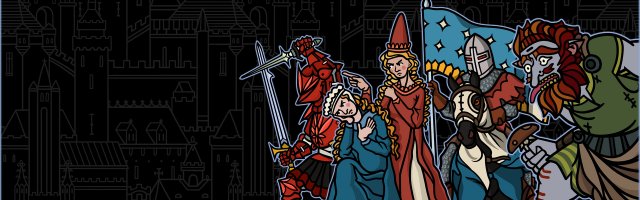
Dicealot does one thing almost flawlessly, though, and that’s the art and sound design. It’s unbelievably charming, and it all contributes to a comically Arthurian adventure. It’s not overly complex, but the visuals alone are incredibly alluring. There’s also a solid level of replay value here; there are 11 different weapons,, and seven difficulty levels, which contribute to a lot of options.
As a whole Dicealot was a reasonably fun, but massively frustrating title. Its overreliance on RNG and awkward run progression makes for a lot of tedium.
Dicealot (Reviewed on Windows)
The game is average, with an even mix of positives and negatives.
A fun, but deeply flawed title that leans too heavily on its random mechanics.




COMMENTS