
PRAGMATA Review
I’ve been playing a lot of Ratchet & Clank and the newer God of War games lately, for both nostalgic and article-related reasons. As such, I admit that when I heard that the next review title landing on my table featured both a gun-slinging hero mechanic partnering up with a robotic ally who rides on their back and heavy themes of parenthood and bonding, it felt more than a bit serendipitous. PRAGMATA, then. Developed and published by Capcom, this sci-fi action thriller promises to be quite the ride.
In the game’s setting, it has been found that our lovely Moon is a rich source of a mineral called Lunum. When refined, this nifty space dust can be compounded into lunafiliment (or lim), which is used to 3D print… well, anything. Naturally, the Moon has hence been made into a gigantic 3D printer to provide Earth with everything needed. There’s an issue, however, as the lads working on the lunar station, the Cradle, aren’t picking up the phone.

The narrative kicks off as we follow a team sent out to investigate the silent treatment, one member of which is our protagonist, Hugh. As the four astronauts make their way into the facilities, a gigantic lunaquake hits, and most of the group meet their untimely end, except for Hugh, who falls into the depths of the structure. Injured and leaking O2, our hero’s survival seems short-lived until a little girl comes along and repairs his suit.
This child, named Diana, is a Pragmata, an android. The two quickly realise they have complementary skills and team up with the mission of reestablishing contact with Earth. Making this a bit of a bother are the machinations of the station's rogue AI, IDUS, which seems to be behind both the missing staff and a small army of rogue robots roaming the labyrinthine halls.

The gameplay of PRAGMATA can be divided into two main categories: exploration and combat. Against my original assumptions, the two facets are actually pretty equal in emphasis and prevalence, which is often not the case in the genre. Instead of one cohesive open world, the game is divided into smaller, slightly linear open areas. While I enjoy a good open world as much as anyone, I do appreciate having a tightly designed level experience. My very serious case of open-world fatigue is only part of that, I promise.
Though the stages themselves are explored in a set order and are limited in size, PRAGMATA does a great job of making each zone feel interesting to traverse, using both vertical design and a metroidvania-esque approach to great effect. Turning over rocks and peeking behind bushes is further rewarded with resources, unique interactions, and a few bits of lore, which is a great way to incentivise the curious without making exploration feel mandatory. This is helped in no small amount by the excellent design, though we’ll get to that in a bit.

Though the adventure itself is enjoyable, it is not without its dangers; the Cradle is currently under the tyranny of IDUS, and the speed with which the AI can print out a group of enemies is honestly horrifying. Hugh is not exactly a trained soldier, so these skirmishes need a bit more brain than brawn, which brings us to the combat.
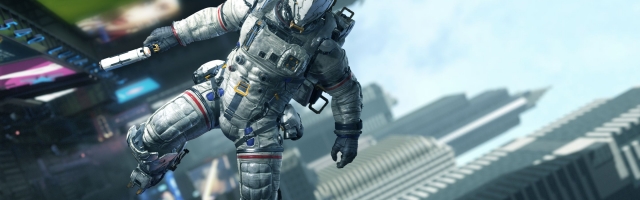
Possibly the biggest unique selling point of PRAGMATA, the fighting can be further divided into two main facets: gunplay and hacking. The former is very much Hugh’s domain, as Diana isn’t equipped with the nifty plasma blades or rockets of the other bots. Using his EVA suit, our hero can leap great heights, use the built-in thrusters to dodge or hover, and rely on the durable plating to take a blow or two. Though not a real combatant, Hugh is pretty adept at zipping around with his gear.

In terms of weapons, our protagonist starts off with a small sidearm with renewable ammunition. As the game progresses, the duo find lunafiliment plans, with which they can print out more powerful, but depletable, tools, which can also be found scattered around the base. These are further categorised under Attack Units, Tactical Units, and Defence Units, all with titular uses. For example, the first Attack model is basically a shockwave shotgun, and the first Tactical item can immobilise enemies with an electric mesh.
Here’s the problem, however: the lunar robots are basically bulletproof. Though they can be harmed, the damage is negligible. This is where our friendly bot comes in! Diana, being the little powerhouse she is, can hack enemy bots and force them to open up their armoured bodies to expose the vulnerable components inside. The hacking itself takes the form of a mini-game where the player must navigate a grid of squares, passing through helpful panels while avoiding bad ones.

With their powers combined, our heroes can take on any mechanical threat! However, experienced readers may be thinking that this kind of system isn’t exactly new. Here’s the thing: both hacking and gun combat are done simultaneously, in real time. So, while the player is avoiding hits and aiming shots, they also have to spare enough brain power to actually hack the enemies in order to deal damage.
I’ll admit, the system took me a bit to get used to, but it is surprisingly easy to grasp. Basically, Hugh is controlled with the thumbsticks, D-pad, and shoulder buttons, whereas Diana’s section only uses the face buttons. It’s very intuitive, even if splitting your attention between so many things can be a bit straining.

Now, the unique combat mechanic is great, but there are a few issues. Targeting specific enemies while in the middle of a hectic fight can be difficult, which is exacerbated by the absence of a lock-on feature. Hugh’s base weapon also has limited shots before it slowly reloads, which can result in weird drops in the pace as the player waits around. The reload time can be increased with upgrades, but it never quite stops being an issue.
Regardless of these few hiccups, the battling is quite fun and even manages to keep the curve of progression and challenge balanced. As the player gains new weapons and abilities, the enemies are also improved, as IDUS introduces bigger foes or advanced versions of old models.

I mentioned that the stages are progressed through linearly, and while that is true, there is a caveat: early on in the story, our dynamic duo find a Shelter, a small area which is safe from enemies and contains useful amenities. Hugh and Diana use this location as a sort of base of operations, and the player can find and unlock special hatches in each level that act as quick-travel points to and from the haven, though enemies do respawn if the stage is exited.
The Shelter offers a fair bit of utility, providing a terminal from which the player can add weapons to their locker and improve them, in addition to unlocking new skills. Whenever they’re ready to head out, the player can even pick the weapons and other gear they want to fit their needs. If Hugh is ever taken out of action, the duo limp back here, ready for some upgrading or loadout customisation.

Outside of gameplay mechanics, the Shelter also lets our protagonists hang out and breathe for a while. An interesting feature of the space is a set of special lim printers which can recreate Read Earth Memories, or REMs, that the player can find hidden in levels. These are basically just items and concepts from Earth, like a television, or a campfire (complete with holographic flame!)
While Hugh himself doesn’t really care about REMs, Diana is absolutely enamoured with them! As the player returns to the area, they may find the diminutive bot playing with a ball or doodling with Crayons. This brings me to, possibly, my favourite thing about PRAGMATA: the character interactions.

Don’t get me wrong, the beginning of the game is somewhat hilarious. Hugh basically goes from loudly stating how he “will never have children” and that “bots are not to be trusted” to being a doting and concerned robo-daughter father in the span of minutes; it’s amazing. However, it’s a short game, running for about 15 hours, so the speedy pace is forgivable.
Rough beginnings aside, the interactions between Hugh and Diana are done amazingly well. The duo form a bond very quickly and play off of each other spectacularly. Hugh comes off as a bit cynical and jaded, but that is very quickly offset by the ball of pure whimsy and wonder that is Diana. It’s no wonder some people on the internet claim the game is a ploy to make the masses want children.

The character progression of our mains is much deeper than it may seem, however, as the game touches on some heavier subjects. The value of artificial life, self-sacrifice, and the meaning of being are all part of the narrative at some point, and it can be a tear-jerker. Though at its core, it’s just nice to see two characters have such a wholesome relationship.
In terms of visuals, PRAGMATA is great. While Hugh’s face is a bit forgettable (I mean, the guy covers it for half the runtime) and Diana’s hair has a life of its own, the general look is very sleek. Even our gun-slinging hero has the look of Isaac Clarke if his suit was designed by Apple. Diana’s animations are also top-notch, capturing her childlike energy and mannerisms perfectly.

However, I found that my favourite aspect of the design was the lunafiliment printing. As the material can be used to print anything, the game often managed to surprise me with its levels. One moment, the player is in a space station, the next they’re waltzing across New York City or a sprawling forest! Additionally, as any avid 3D printing hobbyist knows, sometimes the printing process fails. It’s both cool and disconcerting to see a car suddenly go from metal to spaghetti filaments, after all.
Finally, I need to tip my hat to the enemy animation department. Each enemy has a unique “open” animation where all of their weak points are exposed. These are often amazingly detailed and very creepy, as most enemies are humanoid in some regard. Seeing someone's face split open isn’t exactly reassuring.

The sound design is pretty good as well, favouring an energetic techno vibe in combat while offering a very Resident Evil safe room–esque soundscape for the Shelter. The weapons sound impactful, and the robots are suitably mechanical. Kudos to the team for making the few sections set outside of the Cradle feel like the player is in the vacuum of space.
In terms of performance and bugs, I had only a few issues with the game. Shader caching caused a few crashes here or there, and the FPS stuttered occasionally, but other than that, it was mainly smooth sailing. Weirdly, my Steam was often convinced the game was still running after the program was closed, but I’m unsure if this is just an isolated issue.

To summarise my thoughts, I went into PRAGMATA expecting another classic Capcom-style game, filled with epic combat spectacle and shallow plot. While I wasn’t completely off the mark, I will swallow my pride and admit my error here. While it can be a bit oddly paced, I came out of the experience a fan. The interesting levels, gripping narrative, and great characters kept me coming back, and the linear, but expansive areas made sure I didn’t end up fatigued. I think this may be one of my favourite games of the year and is an instant recommendation.
Pragmata (Reviewed on Windows)
Excellent. Look out for this one.
PRAGMATA is an engaging and entertaining game with both a unique combat mechanic and compelling characters. While the fighting can be a bit slow at times, it is definitely a must-play.

GameGrin are proud to have all their articles researched, written, and edited by real people that care about gaming.



COMMENTS