
Realpolitiks II Review
The Realpolitiks series, developed by Jujubee and published by Fulqrum Publishing, has had mixed reviews on Steam and consoles, and now Realpolitiks II has been released on Xbox Series X|S with a recently-patched bug that crashed the game before you could pick your cabinet. So, is it just as mixed in quality as the PC version, or is there more to it?
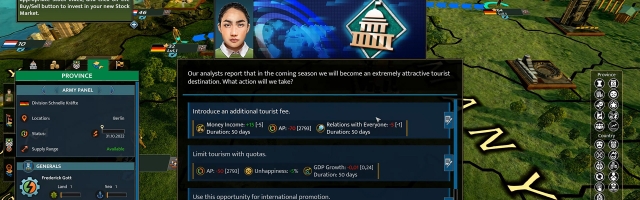
Realpolitiks II is a real-time grand strategy which simulates global politics, where the player must build up blocs with neighbouring nations to complete the game on top of the score ladder via several Civilization-like win conditions requiring extra steps to unlock the opportunity to initiate the endgame. Spread across an expansive map, everyone is open to associate with and antagonise, with random events and mini-missions to complete, rewarded with extra points and resources.

The game’s tutorial is comprehensive but jam-packed with convoluted information that switches off most people before playing the few available scenarios centred around the pandemic. The player is guided as the leader of Poland through over 40 minutes of text walls, pop-ups, and flashing icon tabs, if it doesn’t glitch out and the UI doesn't break. Starting a new scenario or campaign allows the player to pick any country on the planet and the difficulty setting. Each country has its own pre-set difficulty depending on size and political power on the main stage, as well as location.
The country's resources are displayed individually but range from economics, building supplies, and military power stats to overall scores and action points. Buildings and the list of branching skills and policy trees, called projects, are used to increase and outpace opposing nations as well as supply bloc countries with needed funds and government support. The more blocs under your country’s control, the more resources you’ll passively collect from them. Blocs can also be annexed once the player has gained enough support and favour and collected 70 points in social, economic, scientific, or military bloc integration.

Realpolitiks II’s gameplay, as a whole, is a barrier for people entering this type of subgenre in strategy video games, especially on console. Throughout the playthroughs, I had a hard time being engaged with running a country, rather than tinkering with diplomatic relations and insulting the French islands off the coast of Australia. And as a lover of RTS and tactical games, not enjoying my first few hours is a bad sign. The steep learning curve is a main issue, but it is rectified by simply playing more of the game, relying on the player to commit themselves to a long campaign is a gamble. This is ironic because gambling on success is actually the game’s strongest point.
The staying power of Realpolitiks II is the thrill you have when getting away with something naughty which benefits only you. Whereas most games in the genre are a feat of tactics and forward-thinking (which Realpolitiks II also has), the game puts percentages and additional favour and economic tokens to up your chances of pulling espionage on countries, including those in your own bloc.
Being friendly with diplomats and going to funerals of political figures (and the like) are engaging and require careful consideration when choosing which country to be buddy-buddy with, but using spies is where Realpolitiks II goes above and beyond. Funnelling weapons into two warring nations, and stealing top-secret information from your allies, and, I’m not lying, promoting LGBT values into an authoritarian nation to incite free will in their people will always be more fun than declaring war.

In war and other conflicts, troop numbers, ranging from land, sea, and air forces, are dependent on your country’s manpower and whether or not they or you have barracks which hasten deployment. Combat differs from the PC version, replacing the grid mini-game with the dual-bar system from the Crusader Kings series. However, the spies, once levelled up and with certain policies in place, allow the player to perform covert ops and CIA-level antics, like neutralising politicians or destabilising military infrastructure, which can mean the difference between a shorter war and a flimsy peace agreement after both countries run out of money. The player can also watch on the outside as other countries go to war, leading to the computer AI playing out civil conflicts and open battles for everyone to see.
The soundtrack of Realpolitiks II was composed by Adam Skorupa and Jürgen Cialon, the former working on games like The Witcher, Shadow Warrior, and, surprisingly, HATRED. The synth soundtrack of 22 tracks scores the ever-changing gameplay and development of the game, some painting a sense of tension to the player’s actions while others calm the situation. There is also a particular instrument and tone which eerily reminds me of the Dead Island soundtrack while on the main menu. I cannot put my finger on it, though.

Whether sitting back and letting the game play itself or rise to the adventure of total world domination, Realpolitiks II passiveness broken up spontaneous action and strategy is generic if not without the surprised spy-aspects to diplomacy.
Realpolitiks II (Reviewed on Xbox Series X|S)
Game is enjoyable, outweighing the issues there may be.
Realpolitiks II is great for people with a ton of time to kill or who like to relax by simulating diplomatic relations and political scheming. Not recommended for casual players.

GameGrin are proud to have all their articles researched, written, and edited by real people that care about gaming.




COMMENTS