
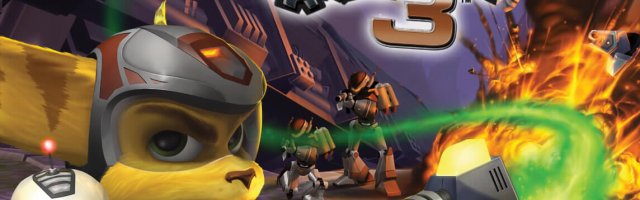
From the Top: Ratchet & Clank Up Your Arsenal
Welcome back to my stubborn journey playing through each game in the Ratchet & Clank franchise that I can get my hands on. If this is your first time looking into this series, I recommend checking out the last two sections to be up to date on what I’ve thought of our spacefaring duo’s heroic journey so far!
Having a second galaxy-saving adventure under their belt, Ratchet & Clank: Up Your Arsenal starts off with our heroes enjoying some well-earned time to themselves at their Megapolis apartment. It appears Clank has started quite a successful acting career in the interim, as the duo catch a clip of Secret Agent Clank, a James Bond-esque hit series starring the little bot.

The reverie is cut short, however, as a news bulletin informs them of a group of aliens attacking a familiar planet: Ratchet’s home of Veldin. Being somewhat protective of his planet despite not visiting for an undisclosed time, our leonine commando (literally) throws a custom-made warp drive into their spaceship, and the two-man team jump back over to the Solana Galaxy.
Making the trip home in more or less one piece, our heroes start fighting off the forces of the invading aliens, the Tyhrranoids. After a few bouts, they make contact with the local defenders, a corps of robotic combatants known as the Galactic Rangers… only they aren’t doing a very good job and unanimously name Ratchet as their new Sergeant five minutes into meeting him.

It turns out that there is an evil mastermind behind the full frontal assault of the Tyhrranoids: one Dr Nefarious, a mechanical genius who has terrorised the galaxy before. The President of the Galaxy (because apparently galaxies have an elected leader) tasks the duo with finding the only person known to beat the bad doctor, thus starting off the newest adventure in the Florana jungle.
Mechanically, Up Your Arsenal is very close to Going Commando, with the movement and controls feeling identical, if not a bit smoother. The quick-select wheel does have a second “page” now, which is pretty sweet. However, where the mechanics themselves are the same, Up Your Arsenal does shift the gameplay away from the series’ platforming roots to a more third-person shooter-focused affair.

Though the game doesn’t completely eschew the puzzles and platforming sections, they are much fewer and far between, to the point where the devs feel it necessary to tutorialise using Bolt Cranks even near the endgame. The levels themselves feel more like skirmishes interrupted by the occasional locked door or navigable gap instead of being a platforming adventure with combat sprinkled in.
One big factor affecting this change-up is possibly the introduction of a PvP multiplayer mode for the first time in the series. While it isn’t exactly bursting with players at the moment, I do remember connecting my PlayStation 2 to the magical world of the “internet” and being yelled at by strangers back in the day, even if it never took off in the same way as franchises like Halo.

Though the multiplayer content was developed by a much smaller team while the majority of staff focused on the main game, the new shift was quite apparent in both the design and new features of Up Your Arsenal. While I’m not interested in the multiplayer aspects regarding this series, I’ll touch on some pertinent bits as they come up!
Adding to this are the addition of two special boxes mixed in with the usual brown variants: the Jackbot and Inferno crates. The former, when destroyed, would double the amount of bolts and experience the player acquires for a short time, encouraging quick progression and riskier combat to get the most out of it. The latter worked much like the star from Super Mario games, encasing Ratchet in special flaming armour known as Infernox, making him temporarily invincible and giving him an extra Omniwrench to beat up enemies.
This power-up, titled Inferno mode, is a fun addition to the general flow of combat, changing a mostly runny-gunny game into a melee brawl; however, it’s also pretty short-lived and can be somewhat situational if your enemies are beyond the reach of your mighty weapons. Weirdly, the second wrench our hero gets is also completely cosmetic, as he only uses the one during attacks.
Consisting of 17 locations (plus the first level in Veldin, which we don’t revisit), the game offers a fair few planets to blast through, with plenty of new areas and a couple of familiar cities from the original to reacquaint ourselves with, such as Blackwater City. Though the locales run the gamut of lush jungles and desert dunes, Up Your Arsenal does seem to favour cityscapes and industrial settings a bit more.

The level design itself continues the familiar formula of small areas with linear paths to objectives, though there is a noticeable increase in combat arenas littered with barricades and other cover. Regardless of the more combat-oriented levels, the game does offer some pretty interesting ideas for planets. For example, one world consists of filming the latest episode of Secret Agent Clank, complete with an irate director, whereas another has you leading a group of Galactic Rangers in a military assault against the Tyhrranoids.
Concerningly, it felt like the game was noticeably more difficult than earlier titles. Enemies deal an astonishing amount of damage at times, projectiles are flying everywhere, and checkpoints are sparse, leading to the player having to repeat long sections. Adding to this annoyance, the few platforming segments the game does offer, usually right before or after difficult fights, have insta-death falls, leading to players having to trudge through fights multiple times due to one small mistake.
Now, though I do complain and did have a few moments where I had to gently lower my controller lest it take flight near the endgame, I did enjoy the experience as a whole. Sure, I will always love the platforming and puzzling of the originals, but there is something to be said for the hectic firefights of Up Your Arsenal.

Speaking of fights, arenas are back in full swing, though we only have the one: Annihilation Nation. This time around, however, the combat planet offers more than just round-based combat: Up Your Arsenal tries to balance the missing platforming by adding special obstacle courses to conquer! While these are fun enough, they are a bit on the short side and are on the one-and-done side of challenges.
The game also introduces one type of arena challenge I absolutely love and want to see in any and all games with multiple weapons: random gun matches. In these fights, the player is given a weapon to use from their armoury at random, with only a tiny bit of ammo to spare. Once the gun is empty, the next weapon is rolled, and the fight continues. It is such a good time and forces the player to think strategically while also letting them play around with multiple armaments in quick succession.

Clank’s solo sections make their return as well, though we seem to have lost the specialist bots of the previous title. Instead, we are joined by a new simian cohort, Skrunch! This little one-eyed monkey is mad for bananas, so Clank must use a special gun to shoot the golden crescents to direct our new ally to push buttons… or become a distraction for larger robots. To be honest, these segments were so few that I almost forgot to add this paragraph, which is a shame, as they were always a good little break from the action.
Hoverbikes and spaceships, regretfully, do not make a return here. However, in their stead, the game does have special sections where Ratchet joins forces with the Galactic Rangers in small missions. These Ranger challenges are often presented as a part of a level, though there is one planet which focuses solely on them.
Each operation consists of multiple short encounters that work towards a larger goal. For example, the larger objective may be to take back an occupied city, whereas one encounter may consist of liberating an anti-air turret, and another could be using said turret to take out dropships. The Ranger missions also have a fair few vehicle segments where Ratchet uses a jeep or hovership to perform tasks.
At its core, the Galactic Ranger operations are basically just a primer for the multiplayer, getting the player to grips with the different game modes, points of interest, and vehicles on offer. Normally, I’d be a bit peeved by the single-player experience being used as a glorified tutorial, but here it works pretty well; it doesn’t not feel too far removed from the other content, the Galactic Rangers themselves are a fun bunch, and the missions are varied and short enough to be entertaining.

Finally, Up Your Arsenal does break the mould a bit by introducing a home base for our heroic duo to return to: the starship Phoenix. You see, after finding and securing the aforementioned only person known to have fought Nefarious (more on him later), our spacefaring duo is invited aboard the cruiser to look into the next steps in the battle against the mad doctor.
The player ends up visiting the Phoenix a fair few times, either to meet up with the newly formed team of, erm, “experts” or to look into one event or another. The ship isn’t that big, consisting of a hangar with both weapon and armour vendors, Ratchet’s personal quarters, a VR training facility, a trophy room, and the (very Star Trek–inspired) bridge.
Though I used to dread being told to “return to the Phoenix” when I was younger, since it was more cutscenes and less rooty tooty robot shooty, I enjoyed the concept of a home base much more this time around. As the area was pretty small, I could get to wherever I needed to go pretty quickly, and the fact that the interior changed to a small degree based on where I was in the story was a nice touch.

A new feature added in Up Your Arsenal is actually related to the Phoenix and Ratchet’s quarters, specifically: the Captain Qwark vid-comics! These games within a game take on the form of 2D sidescrollers, where the player takes control of the titular green-suited “hero” in short platforming and combat sections.
Within the narrative, these games (played on a VG-9000 game system found in Ratchet’s room) are a “historic” telling of the early years of our lovable doofus, Qwark, going through his battles against ghost robot pirates, the slimes of Blackwater, and Nefarious himself, among others. While these episodes are very short and simple, I did enjoy the distraction. Additionally, they are very tongue-in-cheek, with even the in-universe games poking fun at the Captain’s preposterous claims.
Now, before I go on to talk about the enemies, weapons, and characters, it should be noted that Up Your Arsenal has, possibly, the best plot in the franchise so far. Eagle-eyed readers may have noticed I don’t really touch on the narrative of these games as much, and that is mostly because the stories themselves have been mostly a vehicle to drive our heroes onto new planets more than the actual focus of the games. I mean, just look at Going Commando, wherein Fizzwidget would simply call Ratchet after a level was done, only to give the next task with little rhyme or reason in-game.

In the third instalment, the plot progresses much more naturally, with in-game events having a better narrative flow; we’re fighting a war against Nefarious, defending against his attacks while also trying to learn more about his plans, and the planet-hopping progression mirrors that. Additionally, this is also the first time we have witnessed the enemy landing a decisive blow mid-game!
At about just over the halfway point of the game, Nefarious reveals his evil scheme: using a gigantic device known as the Biobliterator, he aims to turn every organic lifeform into a robot… and does exactly that to a planet’s worth of Tyhrranoids as we are fighting them. It’s honestly a pretty surprising scene and, upon deeper reflection, a pretty horrifying prospect. Our heavily-armed duo even see one of their friends hit with the same weapon and turned into a robot hell-bent on destroying the “squishies”. It’s unnerving stuff.
It’s not exactly a gripping drama or space opera, but it is an intriguing enough concept to keep you entertained and rooting for the ragtag group of heroes fighting against the mechanical menace. The game also doesn’t take itself too seriously, so the horrors of forced robotification and reprogramming are countered by jokes, gags, and poking fun at coat-turning politicians.

Now, onto those enemies I was talking about!
Up Your Arsenal is a bit of a mixed bag in terms of its combatant cohesion, though it starts off pretty strong with the Tyhrranoids themselves. These weirdly cute, large-mouthed bipedal creatures are a great enemy to add to the roster, as they have a very clear visual image and progression. You start off fighting little guys that do little more than nibble at your tail, and then slowly move on to larger weapon-wielding brutes and flying saucers! They even indicate the toughness of a Tyhrranoid via the number of eyestalks they have: more eyes, bigger problems.
This excellent design is both heightened and slightly blighted by the aforementioned robotification, however. In concept, it is a very cool bit of visual storytelling and gameplay, as all of the aliens do become metallic and more aggressive… regardless, they fall short in practice. Yes, they look different, but the game doesn’t introduce any new tactics or variants of the foes, so they feel more like palette swaps than anything. The metallic look also isn’t great, as it seems the original model is simply re-coloured instead of adding any new bits or bolts.

Regretfully, the other enemy designs are very hit or miss and don’t really fit into the world as neatly as previous games’ enemies have. Sure, the local foes of the planets are fine, like the returning Ameboids or Gladiators, but the robotic combatants are all over the place; we have the usual fare of smaller robots attacking in melee and from range, but then we have robot… ninjas? With lightsabers? It just feels a bit off from the usual somewhat cohesive design. Then again, ninjas are always cool, so maybe I’m the odd one out here.
Regardless, I felt Up Your Arsenal had difficulty nailing down the visual language of the opposition a bit, as I had more trouble telling the enemies apart at a glance and couldn’t identify new variants as easily as in the previous game.
As an aside, the game does have an enemy I am completely fine with: the Lawn Ninjas. Now, before you deem me completely unpleasable, I have my reasons! First of all, they’re literally garden gnomes with katanas; that's amazing. Second, these Megacorp defence solutions were mentioned and shown in Going Commando, even though they were never seen as in-game dangers, so they get a pass.

Moving on to Ratchet’s kit, armours make a return, although they can only be purchased while on the Phoenix. Consisting of four upgrades to our hero’s base layer, as he apparently forgot his Carbonox at home, the suits have a fun bit of progression themselves. Each new upgrade makes Ratchet bulkier and covers more of his body, with the final plate, Infernox armour, adding a fully covering helmet.
Though there are fewer vendors for the protective gear to go around, the increased amount of enemies, projectiles, and damage makes keeping your armour up to snuff mandatory. Luckily, the second-best suit in the game, the Aegis Mark V, is relatively cheap and has a hefty damage reduction of 66%, so it’s not a horrid chore to keep abreast of.
In terms of weapons… well, we hit a bit of a bother. Starting with the positives, the level-up system from Going Commando makes its return, though this time around, instead of evolving as soon as the experience bar is full, each weapon has five levels. Though a gun changes its name and possibly gets some alternate capabilities upon reaching the final stage, every upgrade adds something visual to the armament's design, which I adore!

The mods introduced in the earlier title are also fitted into these upgrades, so a gun may suddenly be able to lock onto enemies once a new level is gained. Weirdly, the game doesn’t always tell you what changes during each power-up, so you’ll have to check the weapon descriptions.
Then we reach the issue I have: the variety of guns is on the weaker side. Don’t get me wrong, there are plenty of weapons to go around (about 20), but of that list, five are returning guns and an additional four are what I consider “rehashed” versions of arms we’ve already seen. To be fair, this is in no way egregious, especially with the newly implemented five-tier upgrade system, but it feels a bit disappointing to see so few fresh ideas.
As for the reshashed returning guns and their differences, these are weapons you can buy from the regular Gadgetron vendors (as opposed to getting the returning boomsticks from a separate seller found only on one planet) that seem to be a slightly modified version of a weapon we’ve seen in earlier titles. For example, the Suck Cannon is a slightly refined iteration of the weapon of the same name from Ratchet & Clank, and the Disc Blade Gun feels like a reskinned Chopper from Going Commando.

While I personally found these a bit uninspired, I do think this was an intentional bit of design, at least. You see, our gunslinging heroes are returning after some time abroad, and these familiar-but-new guns are meant to both hearken back to the earlier games and give a feel of Gadgetron having made advancements in their lineup. The guns that resemble anything from Megacorp are, naturally, the result of industrial espionage!
To give credence to this theory, the game even references the time our heroes have spent away. You see, if a player happens to have a Ratchet & Clank savefile, they are given a 10% discount on all Gadgetron products. Why? Well, in the first game, Ratchet is actually hired as an employee of the corporation as a reward. A throwaway line states that all hirees receive a brand-wide discount… after two years of employment. Can you guess how long it had been from the release of the first game to the release of Up Your Arsenal? It’s a lovely touch.
In terms of returning guns, it seems Insomniac Games has learned its lesson from Going Commando, as these old reliables can also be upgraded using the same five-tier system! Not only did this make them viable choices alongside the game’s other tools of destruction, but it also allowed the devs to play with the interim upgrades… while also fixing a major crime from the original: the Lava Gun.

Yes, I’m still mad about that, and so were other fans! So much so, in fact, that the devs made sure to change up the final form of the arm from the original Meteor Gun into the Liquid Nitrogen Gun. Instead of changing the fundamental mechanics of the weapon, the new form keeps the amazing crowd-controlling capabilities of the stream of scorching magma, while adding the ability to freeze enemies. No notes.
We start the game with the usual grenade-chucking implement, though Up Your Arsenal does change it up a bit by giving you a shotgun as a second weapon, instead of a blaster! From thenceforth, the arms we gain really ruin the gamut of “a basic blaster, but big” to “thing that shoots mind-altering goop” with very little in between the two extremes of basic and wacky.

Regretfully, the power creep is still an issue, though possibly a bit less than in previous renditions. The game does seem to favour the returning weapons a fair bit, as the damage they deal is leagues above some of the “normal” weapons. I know I complained about weapons from the first game being useless in the second, but this seems like too much of a correction, where the new, fancy munitions are kinda overshadowed.
Ratchet’s trusty Ominwrench does not gain any upgrades this time around, which is a bit strange, but considering the new focus on being a shooter, perhaps this is intentional. Muddying this thought, however, is the fact that one of the new weapons is a plasma whip that is strictly melee-focused. Regardless, I didn’t really use any melee outside of the arena fights in general, so perhaps the point is moot.
Looking at weapons that stuck out to me, this time we have two impractical and fun guns, and one that was intriguing on paper, but horrid to actually use! Starting off with the positive, the Infector was one of the more creative arms in the game. When fired, it would spew a (literal) glob of goo that would ooze towards enemies, infecting them with a nano-virus that both dealt damage over time and turned said target hostile to other foes in the vicinity.

While not the most effective tool, I enjoyed how the Infector could be a good opening gambit whenever a firefight broke out; spit a glob at one enemy, focus fire on the other and then take out the first with ease. Getting the firearm to actually hit the intended target was a bit of a pain, as the goo would splortch onto the first enemy it came near, sometimes simply disappearing altogether, but thankfully it happened seldom enough not to dampen the feel too much.
The second weapon I really enjoyed was the Rift Inducer, which felt very much like a Ratchet & Clank armament. Whenever fired, the gun would shoot out a literal black hole that would rip enemies apart, if they were close enough. Multiple shots could be combined to make the rift bigger, allowing larger enemies to cross the event horizon, and it was just a fun time! Who doesn’t want to use weaponised black holes, after all?
Then we get to the Holoshield Glove. A new addition to the passive category of tools, this weapon would, upon use, create a translucent forcefield in front of Ratchet, protecting him from projectiles for a limited time. Absolutely top-notch in theory, as the number of bullets in the air on average was quite high at any one moment, but the shield itself falls short in terms of design.

You see, the protective field has no way of informing the player when it was about to run out of juice. So, one second you’re smugly safe behind your shield and the next, bam, free haircut and barbecue in one. This may sound like a small issue, but it made using the weapon a gamble that usually didn’t pay off.
Adding to these points, the Holoshield Glove gained experience based on the amount of damage it absorbed, meaning the best way to upgrade it was to throw it down and wait without attacking, leaving players to twiddle their thumbs in the middle of an epic battle. Not a great look.
The ever-present “change enemy into a barnyard animal” gun is back yet again, this time in the form of the Qwack-O-Ray. As one can assume, this time around, enemies are transformed into the humble mallard. However, unlike the passive animals of the past, these ducks are anything but! As the weapon is levelled up, these feathered friends will start to lay explosive eggs, grow teeth to attack enemies with, and even have a chance to transform into a mighty phoenix!
The deadliest rocket launcher in the galaxy makes its third appearance in the form of the RY3NO, which I have no idea how one would pronounce. The “Rhye-Threeno”, maybe? Anyway, the devastating gun now shoots a salvo of eight rockets at once, all of which will seek out any enemies nearby. The design of the weapon is pretty decent, with sharp spikes and a large nozzle.

Interestingly, Up Your Arsenal makes series history by making its rendition of the RYNO upgradable, turning the weapon into the RYNOCIRATOR upon reaching the fifth level. Instead of shooting individual salvos of rockets, this tool of destruction functions similarly to the Zodiac, reducing every enemy in view to ashes.
In terms of Gadgets, the game has taken a noticeable step back, condensing the multiple tools of the previous titles into four main tools: the Hacker, Hypershot, Refactor, and Tyhrra-Guise.
Continuing the theme of condensing, the Hypershot is a great example, as it is basically a combination of the Slingshot and Dynamo seen before. In an amazing bit of QoL improvement, using the Gadget is now context sensitive, so pressing the fire button near a relevant target would now automatically use it! This is an amazing improvement, as it cuts down on menu shenanigans quite a bit.

The Hacker, as one may infer from the name, is the dedicated item used for breaking and entering, with a very arcadey and weirdly addictive little mini-game used to unlock the many doors spread throughout. This is possibly my favourite iteration of this Gadget, offering a good balance of difficulty and length.
The Refractor is possibly the most-utilised Gadget out of the bunch, right after the Hypershot. Used to redirect lasers in very Legend of Zelda–esque puzzles, the tool is nothing especially groundbreaking, but still fun enough to use.
Frustratingly, the game does have a few interesting ideas with the Gadget that aren’t expanded on. For example, in one section, a ray of light is used to lure a spiderbot to a specific position. The way the robot moved and followed the laser felt new and fun, but it's the only instance it is used.
Finally, the Tyhrra-Guise was a fun little tool, though it was only used a few times. When used, the device would make Ratchet look like a Tyhrranoid and even allow him to speak the local language, Tyhrranese, enabling him to blend in with the eye-stalked aliens. Communicating via the device took on the form of timed button prompts, with correct inputs leading to clear and concise speech and errors leading to Ratchet calling someone a nine-toed Snagglebeast.

Honestly, every dialogue involving the Tyhrra-Guise is a good time, and it is a definite shame it is not used more often.
In terms of characters, Up Your Arsenal is a mix of familiar faces and new acquaintances, with some emphasis on the former. The game stands out from the series so far in how often we actually interact with the same person more than once, helped quite a bit by the introduction of a base where a lot of them hang out.
Among the more prominent new faces we meet are the President of the Galaxy, Phyronix, and his daughter, Sasha. While the former is not seen as much, he does turn up in key points and is, well, the President. While I’m not completely convinced, it seems his personality and manner of speech are based on former United States President Bill Clinton.
Sasha, on the other hand, is a much more active participant in the narrative, as she is the captain of the Phoenix and basically Ratchet’s commanding officer. She is professional, but also has a sense of humour and passion for her job. The chemistry between the captain and our furry protagonist is well done and has a somewhat natural evolution as they work together, though Sasha doesn’t actually get to do much beyond giving orders and hanging out on the bridge.

While I do miss Angela, Sasha is a good character and distinct enough not to feel like a carbon copy replacement. Regardless, it would have been nice for her to get the chance to prove her skills and earn her place during the narrative, instead of being the token love interest.
As I mentioned before, the Galactic Rangers are a fun bunch, even though they are a regiment of identical green bots. They have varying personalities, are funny, and do get to prove their effectiveness near the end of the game, even if two-thirds of the time they are basically useless. What’s not to love?
Then there’s Dr Nefarious and his butler, Lawrence. Possibly the best antagonist the series has spewed out, something is captivating about the maniacal robot and his simultaneous bumbling and efficiency. Whenever we see him in action, Nefarious seems to be flying by the seat of his pants, being foiled by the smallest things, but he also manages to get the furthest in his plans for world domination than any other villain before!

Cranky, loud, prone to outbursts of anger, and easily distracted, Nefarious has the makings of a pretty forgettable foe, but it somehow works in the case of this mechanic madman… helped in no small part by the other half of the duo, Lawrence. Where the good doctor is loud and brash, Lawrence is quiet and stone-faced. He’s basically the straight man to Nefarious’s explosive personality.
However, even that may not be enough to sell the duo in most circumstances, where the fact that Lawrence is possibly the most passive-aggressive lackey I’ve seen! Constantly rolling his eyes at the doctor's hijinks, undertaking malicious compliance when it suits him, and generally doing his own thing with little care for anything else, Lawrence is a great character that ties the duo together wonderfully.

As an aside, the game also has a Britney Spears expy, Courtney Gears, that acts as a fitting Fem Fatale to Clank’s secret agent shtick; she even has a pretty bopping musical segment! There's also a short subplot about Clank being replaced by an evil replica named “Klunk”, but it doesn't really go anywhere.
Moving on to returning friends, the roster is a bit of a mixed bag. From Ratchet & Clank, we welcome back the personal assistant, Helga; the hoverboard champion, Skidd McMarx; and the tech genius, Big Al. Though both Al and Helga show up every now and again, with the former being heard often on the Phoenix’s tannoy system, it’s Skidd that ends up being one of the more prominent characters out of the bunch.

Featuring in multiple missions as an ally, getting kidnapped by the enemy, and even being turned into a robot via the Biobliterator to drive home the stakes, Mr McMarx does not have the best luck within the narrative.
Naturally, everyone's “favourite” hero also makes a return and gets mixed up in the plot as a whole. A surprise to very few, the “one person to fight Nefarious” turns out to be our very own Captain Qwark. Found in the Florana jungle, the big man seems to have lost his memory and convinced himself he is one of the local apes.

After a quick defeat at the hands of Ratchet and a quick speedrun of his past via the vid-comics, Qwark is quickly returned to his normal, flexing self. Being assigned to head the counter-offensive against Nefarious by the President and forming his very own team, the Q-Force, out of the Phoenix’s crew, Qwark wastes little time being too big for his britches.
Jokes aside, it’s strangely nice to actually work alongside the green titan. He has the same energy as characters like Kronk from The Emperor's New Groove, where you can’t help but love the meathead. The big lug even has an honest-to-goodness character arc where he goes into hiding once things get risky, only to return at the 11th hour to help Ratchet after getting a classic “you could be a real hero” speech from the protag duo. The story leans a lot on how arrogant and selfish the guy is, but I can’t help but think this may be his best showing nonetheless.
Moving on to our main duo, I think Up Your Arsenal does a good job of giving both characters a bit of the limelight. Flipping the prestige they had in Going Commando, this time around, it’s Clank who everyone recognises and Ratchet who is disregarded. I think being popular has done wonders for the little robot, as he seems more active and emotive in the narrative. He even gets a few sections to himself, being both the star of his hit holovid show and the prisoner of the big bad.

The game also shows just how much of a team our main duo have become, with them trusting each other implicitly. Once Ratchet learns that the Clank strapped to his back was indeed a fake, one could expect the two to have a falling out once they got back together, but no! They both take responsibility for their failings, pick each other up, and go after the actual culprit.
Some may find their almost-perfect teamwork and trust in each other to be on the boring side of storytelling, but I personally think it is more the culmination of the last two years of hardship and working together coming to fruition. I am, however, a notorious sucker for a good bromance.

Ratchet himself has some great evolution during the game as well. Though he struggles with not getting the recognition he feels he deserves, it never drives him to do anything stupid or reckless; on the contrary, it just acts as a motivator for him to prove everyone wrong.
Up Your Arsenal also continues the evolution of his character that he has been on throughout the series. In the first title, he came to grips with himself and being a hero. In the second, he became a professional working for an organisation as an elite combatant, and now he is tasked with leading a group and looking out for its members. It's a very subtle bit of character progression which I never noticed until making this series!
Ratchet & Clank: Up Your Arsenal is a bit of a mixed bag. On one hand, I love the narrative and characters, but on the other, I’m unsure if the focus on gunplay was a smart move. To me, at least, a big part of my appreciation for the series was how well the games mixed platforming, puzzles, and combat. The new formula just didn’t entertain in the same way, with firefights taking a bit too long and the usually refreshing puzzles too few and far between.

Don’t get me wrong, Up Your Arsenal is still a great time and adds some great features to the franchise; I just feel it lost a bit of its identity in the journey.
And so, we near the end of the PlayStation 2 era of Ratchet & Clank, with one last title to explore, even if it feels more like a spin-off than anything else. Join me next time as we dive into Ratchet's short-lived life as a professional gladiator in Ratchet: Deadlocked and find out if condensing the entire experience down to nothing but arena fights is a good idea.

GameGrin are proud to have all their articles researched, written, and edited by real people that care about gaming.


COMMENTS