
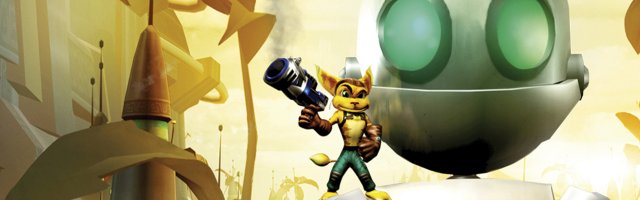
From the Top: Ratchet & Clank Size Matters
Welcome back to my mad scramble to play through as many of the games in the Ratchet & Clank franchise as I can get my hands on before the PlayStation Store removes them. So far, we’ve covered the original four games on the PlayStation 2 and are looking toward the Future trilogy on the PlayStation 3. Before we get there, however, we have a short few stops in handheld land to get through.
If this is your first time joining me in this rambling, I do suggest checking out the series so far. Though each article touches on a single game, I do tend to ponder the evolution in mechanics, game design, and story to some extent throughout my journey.

Today’s topic, Ratchet & Clank: Size Matters, is an interesting title in a few regards. To begin with, it is the first proper spin-off title in the series, while also being the franchise's first foray into the sphere of handheld gaming via the PlayStation Portable. Second, the game is also the first not developed by Insomniac Studios, instead coming from High Impact Games (though, to be fair, the studio was formed by former Insomniac lads).
Released in early 2007, only a few months before Ratchet & Clank: Tools of Destruction, Size Matters is a bit of a mystery in terms of continuity. Though it clearly takes place some time after the events of Deadlocked and Up Your Arsenal, multiple facets of the game seem to call back to the very first title!
The plot kicks off in the tropical resort planet of Pokitaru, where our heroes are catching up on some well-earned R&R. Their rest is cut short, however, when a little girl named Luna comes up to them, asking to snap some photos of the two in action for her school report.
 Only too happy to help, the duo (mostly Ratchet) leap at the chance to show off, which goes as well as one can imagine. The resort is attacked by an unknown force, Luna is apparently kidnapped, and our heroes (plus a glory-hungry Qwark) shoot off into space in pursuit, starting the game proper.
Size Matters is, mechanically, very similar to the first Ratchet & Clank, with movement feeling a bit floaty and the camera feeling somewhat… awkward. This is probably due to the viewpoint being more zoomed in than in previous instalments. I guess that the change is there to balance the technical limitations of the PSP. Along the same lines, the device’s controller layout, having only two shoulder buttons instead of the earlier four, made for some very weird design choices.
For example, to perform a long jump, one must now press both shoulder buttons. While it’s not too bothersome, the game could be a bit of a stickler for the timing. I also played through a fair bit of the game under the impression that it simply didn’t have strafing as an option! Turns out, you walk around normally with the thumbstick and use the directional pad to strafe. Not exactly intuitive, especially in the thick of combat.

Regretfully, the awkwardness of the controls is also present in the game's general visual image, with textures especially feeling very lacklustre, even for the handheld. Some of the destructible crates look like they’re from the PlayStation era! The characters seem to have also taken a break in the uncanny valley, with Ratchet himself sporting the most vacant yet manic grin I have seen in videogames so far!
The combat itself has suffered, though I don’t think I can lay the blame on the console this time. Enemies are very spongey and dish out damage at a ridiculous pace, making the many encounters feel unbalanced. This is especially evident in the few boss battles, as the difficulty shoots up like the Harbinger’s satellites. You can even get stuck in a baffling loop of diminishing returns, as the game does not give you your ammo back on a loss, forcing you to spend more and more bolts to rearm.
Now, I know I just complained for four paragraphs straight, but it is not all bad. Surprisingly, Size Matters manages to bring back a lot of the creativity in level, character, and weapon design that a few of the latter games in the PS2 era were missing. Instead of fighting through war-torn battlefields and arenas, we go through a spaceport, a farm, and a medical suite, for example. We even have an honest-to-goodness dream sequence where our hero is forced to fight chainsaw-wielding Qwarks while PNGs of villains past float around in an endless void!

The game returns to the franchise’s standard formula of planet-hopping adventures, where each new locale has a semi-linear adventure that leads to the next. Unlike quite a few other entries, Size Matters is a pretty one-and-done affair when it comes to the levels, with places being visited only once in terms of the critical path.
As a slight tangent, when it comes to franchises releasing a title for the PSP, a common result is a game with the bare bones the series is known for, combined with an overabundance of weird mini-games. Just look at Daxter, the inbetweenquel of Jak & Daxter: The Precursor Legacy and Jak II! Sure, there is some platforming action and combat, but it also has these weird sequences where the fuzzy protagonist would act out a parody of a popular movie scene, like fighting Agent Smith in The Matrix.
I’ve always wondered how developers came to this conclusion. Was it due to the PSP’s limitations, an attempt to reach a broader audience, or maybe just something the handheld market demanded? In any case, Size Matters follows the same design philosophy.

The mini-games can be divided into two main categories: revamped returners and new friends. The former represents features we’ve seen before that are back, though with a new set of bells and whistles. The first of two such instances is Skyboarding, which is basically just hoverboarding with some added vertical movement. Though the ability to ascend and descend was a neat little addition, the races themselves were a bit of a bore, with some frustrating rubber banding.
The second case is a new kind of Giant Clank section, where our mechanical buddy takes off into space to fight his way either past or to a bunch of enemies. The closest thing I can compare these segments to is the Gummi Ship in the Kingdom Hearts franchise. It’s like an on-rail shooter, though you also have to dodge incoming obstacles. I hated these bits, as the difficulty was often frustrating, combined with a long length and few checkpoints.
Moving on to the new mini-games, they all revolve around our robotic partner. In Size Matters, Clank has the ability to gain control of certain devices by hopping into them, like a mecha suit (the implications of which I choose not to think about), with accompanying side content related to each new “form”.

First off, Clank can take part in a Robot Wars–esque arena battle wherein he controls one of three different types of chassis, each with its own unique abilities. The main goal is to crash into any opponents and take them out before they do the same to you! I was dubious about this little mode at first, but it honestly grew on me quite quickly. The frames you could pilot were interesting enough to keep me entertained, and the matches were pretty quick. I’m surprised this didn’t spawn a spinoff.
Our mechanical ally can also play an odd combination of football and basketball, where Clank must pick up a Gadgebot and throw it onto a goal, while an opponent attempts to knock the little friend out of his hands to do the same. These matches were rather short and easy, but fun nonetheless, especially with four total contestants milling about.
The game additionally has a few sections where Ratchet busies himself with unlocking a door or fixing something, necessitating Clank to keep him covered with a mounted turret. Enemies will skitter in from the sides, slowly making their way to our gearhead hero, unless they are hit multiple times with a freezing shot.
Finally, you could play Lemmings. That’s it. Just a carbon copy of Lemmings, but with Gadgebots.

The mini-games are, as per usual, a fun little change-up. However, Size Matters has a weird habit of giving the player all of the side content to do at once, instead of parcelling it out throughout the narrative. It’s not an issue, but for someone who likes to do all of the available optional stuff before progressing, it was a bit of a pace-killer.
In addition to a bunch of side activities, Size Matters does introduce a mechanic I was not expecting to see for a while yet: armour sets. You see, Ratchet starts the game sporting his classic Ratchet & Clank look, complete with lack of shirt and shoes. As the narrative continues, the player can find and earn pieces of protection to wear, each belonging to one of seven sets.
While increasing damage reduction is their main use, completing a set would also give our wrench-swinging protagonist a special ability, like a blast of lightning upon hitting the ground. In a bit of genius design, these sets can even be mixed and matched to unlock secret combinations, complete with unique abilities! I love it when games do this, as it’s a clever way to incentivise creativity and experimentation.

Though I like the system in general, there is one problem: to get all of the pieces of gear, you need to play through the game a minimum of three times. The last two suits, the Hyperborean and Chameleon, respectively, only become available when starting the game in challenge mode for the first and second time. It’s not a deal-breaker, but considering I didn’t exactly love my first playthrough, demanding two more for completion is a bit of a hard ask.
In terms of weapons… well. As I mentioned earlier, the enemies are pretty spongy, making most of the guns feel ineffective. Especially the starting blaster, the Lacerator, has such low damage that using the Omniwrench is preferable by far. So, going forward, I’ll not harp on this failing overmuch, as it is pretty prevalent throughout. Just keep it in mind if you feel the need to compare entries in the franchise.
Much like in its level design, Size Matters does manage to bring back some of the series’ charming creativity in terms of guns. Sure, we have the ever-present blaster, shotgun, grenade launcher, and rocket launcher, in addition to a few returning arms, but an attempt is made at least! In an odd turn, possibly as an over-correction from Deadlocked, the weapons have a total of four upgrade levels, instead of the five or 10 seen so far.

Before looking at the new armaments, a quick nod to our old friends. The Suck Cannon is back yet again, sporting its Up Your Arsenal look. It seems this ordnance has reached its zenith, as it’s pretty much unchanged. We also have the Glove of Doom, which throws out Agents of Doom to help battle enemies, as before.
A few edge cases are also introduced. These weapons are not direct call-backs to earlier games, but are pretty much the same thing with a new name tag. For example, the Scorcher is basically an expy of the Pyrocitor and the Static Barrier is just the Shield Charger. I don’t mind these, as the guns do come into their own a bit more with the addition of weapon mods (more on them in a bit).
Looking at memorable new additions, there are a few that I enjoyed using. The first to come to mind, and also a good example of the “wacky” weapons, is the Bee Mine Glove. Basically doing the exact same thing as the many variants of the Mini Turret Launcher, the glove would throw out a small beehive onto the ground, which would then release a cloud of mechanical (and explosive) bees at any enemy foolish enough to get close. I know it’s pretty much just a turret with extra steps, but I just found the whole idea charming… and just a bit morbid, considering how machines seem to have sentience in the Ratchet & Clank universe.

Another fun little tool was the Laser Tracer. This hefty bit of kit fires a beam of burning red light on use, which the player can direct. It packs quite the punch and is surprisingly ammo-efficient, though it does have the drawback of forcing Ratchet to stay still while firing. What really made the weapon great for me, however, was the fact that the beam acted as a sort of shield. As the laser is fired, it expels enough heat and pressure to create a barrier that blocks most damage.
This combination of imposed immovability and shielding is a fun tactical addition, making the player gamble between dealing and receiving damage. I really hope to see more of this kind of thinking in future instalments, though my memory tells me I may be in for disappointment.
Continuing the traditions so heartlessly broken by Deadlocked, Size Matters not only has a RYNO variant, but also an enemy transfigurator! The Mootator (or Armoogeddon upon evolution) is part of the latter category; it's a ray that transforms foes into bovine creatures that explode when approached. Though a bit slow, the gun is still as fun as always.
Now, the RYNO is a bit of a problem. Mechanically, this tool of destruction is much like before, firing multiple missiles that deal massive damage. However, instead of firing them in a stream of obliteration, this model actually fires them at once, much like a suped-up shotgun even Doomguy would envy! This can be a bit frustrating, as you need to be quite close to get a proper hit. Upon reaching its fourth level, the weapon turns into the RYNOCERATOR, gaining more damage and rockets.

The clunky use isn’t the real issue, however. No, it’s the price. The bloody thing costs an eye-watering 9,999,000 bolts, which is simply ridiculous. Even with the bolt multiplier of Challenge runs, it's simply too expensive to buy, especially for the result.
The weapon modification system in Size Matters is very similar to Going Commando, in that each gun has a few options available for purchase from Slim Cognito. However, this time around, you simply use normal bolts instead of the rarer Titanium variety.
The enhancements themselves are pretty fun, adding new facets to how the armaments operate. For example, the flame-spewing Scorcher can cough up a fireball after the player stops shooting, and the Suck Cannon’s ammunition can be made to bounce, adding quite a bit of damage. The downside to this system is that Mr Cognito doesn’t show up too often, and the mods can be a bit on the pricey side.

Size Matters has a total of eight Gadgets to collect, though only three are new. The rest are the, at this point, ubiquitous collection of Hypershot, Heli-Pack, and various boots. The first new tool we gain is the Sprout-o-Matic, which is basically a high-tech watering can.
With this Super Soaker, Ratchet can awaken and lead tiny flowers, known as Mimic Plants. By guiding the little sprout to a special plot of soil, it will grow into a special plant with unique abilities, such as explosive seeds or catapult-esque limbs. While a fun concept (and very reminiscent of the Charmed Ridge level in Spyro 3: Enter the Dragon), this Gadget isn’t really used much or explored.
The second bit of tech is the Polarizer, a tool that can reverse the polarity of magnetic objects. Used in a few puzzle segments to move objects or platforms, the Gadget is much the same as the Sprout-o-Matics in that it’s not explored or used enough to be interesting.

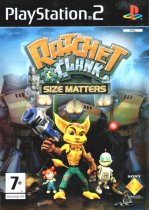
The final item is a bit of a stretch, as it is technically not a Gadget as such. The Shrink Ray, around which many of the game's events revolve, does what can be expected: it can make people or things gigantic or teeny tiny. Now, based on the cover art for the game, players would be forgiven if they assumed there would be sections where a small Ratchet or big Clank would have to work together. However, in truth, this is seldom the case.
I can bring to mind only one occasion where one of our heroes changing size was actually somehow prevalent in gameplay, as in most cases, the environment itself was equally big or small in comparison to the player. In-game, this is explained by the introduction of Technomites, minuscule inventors who are to thank for many of the mechanical and scientific advancements of the world. So, whenever our party shrinks down, they’re simply hopping from the “normal” sized world into the microscopic world of the mites.
This is a bit disappointing, as I do tend to enjoy exploring commonplace locations from new perspectives, and being tiny is often a great way to make the familiar feel alien and scary. Regretfully, we see much too little of this during the game’s events… though I admit, the resolution of the narrative did make me laugh. More on that in a bit.

To its credit, the Shrink Ray IS used creatively in the ever-present hacking mini-game the series is known for. Instead of having a dedicated tool for the job, Ratchet simply shrinks himself and hops inside any offending lock in his way, playing through a short rail-grinding segment to disengage the device.
In terms of enemy design, Size Matters does a good job in general. Planets often offer some unique foes that are tied to the location, like surgeon bots and nurse droids populating a surgical suite, or Ratchet’s nightmare world being populated by deranged Qwark doctors and flying hypodermic needles.
Where the game does drop the ball, however, is the depiction of the two main antagonistic forces of the game. Starting with the newly introduced Technomites… I was a bit unsure of what they actually look like. We do fight a few purple-ish humanoids, whom I assume were the Technomite forces. However, we then have the big bad, Otto Destruct, who looks nothing like the common bruisers, making for a very confusing bit of design.

The second group is the more interesting: a small army of Ratchet clones. During the events of the game, our hero is captured, allowing the enemy to extract some DNA. With said sample, Otto is successful in creating an elite force of combatants, though he didn’t simply stop at a 1:1 copy!
The Dupli-Lombaxes come in three main flavours: basic, fast, and bulky. The first is a more-or-less exact copy of our hero, armed with either a wrench or a blaster. The second and last variants seem to be the result of Mr Destruct playing with attribute sliders. Fast Ratchets are slim and lithe, running at a breakneck speed; armed with a flamethrower, these speedy foes are a terror in large numbers. The last variant, the Bulky Ratchet, is the polar opposite, moving slowly and being built from damage-absorbing muscles.
I thought the concept was a great little idea. Using the players' gear and skill against them is often an interesting twist and can make for some memorable moments… though I do admit that in this case, fighting the enemies themselves was a nightmare and a half. Ridiculous damage and health are not a fun combo, especially when paired with numbers.

The weirdest thing about the clones, however, is how the matter is resolved. After facing Otto and dealing with his machinations, our heroes realise there’s still an army of faux-Ratchets around. At first, this seems like a pretty bad situation, until they realise: “Oh yeah, we’re currently shrunken down”. One re-sizing later, the previously threatening fighters are about the size of a thumb drive.
So, what to do with a horde of tiny fighters with no leader? Why make them into a commodity, of course! Yes, the end resolution of the game is that these sentient clones of the galaxy's greatest hero are made into Battle Ratchets, a purchasable toy. Man, that is both dark and hits a bit too close to home.
Looking at character design, there is not much to say about Size Matters. The new additions are pretty forgettable, with very little personality being portrayed. For example, I don’t think we ever hear Otto’s last name spoken aloud. The little girl in the beginning, Luna, turns out to be a robot à la Meet Dave, though it goes nowhere. An attempt is also made to add an expy of Skidd McMarx in terms of the Skyboarding segments, though I’m unsure if they even have a name.

Clank is pretty much his usual self, though it’s nice to see him get a bit more screen time — also paving the way for the follow-up title. Ratchet, however, feels like he has regressed to his Ratchet & Clank persona. He is demeaning, arrogant, and straight-up mean for most of the runtime! Thankfully, his attitude does improve near the end, and he is suitably humble after he is shown to be wrong on multiple occasions.
Finally, Captain Qwark is a seldom occurring presence in the narrative, though not much is done with the guy. There is a subplot about him looking for his parents, and Otto somehow convincing the good captain that they are related, but… it’s mostly bad filler.

I had low expectations going into Ratchet & Clank: Size Matters, but I still managed to be a tiny bit disappointed. I will say that the creativity being shown was very good, and it managed to capture the heart of the series better than some mainline games! However, the clunkiness of the gameplay and unsatisfying combat make it a bit of a chore to play through. Though I do think it’s worth playing (once), if one had to pick any game in the franchise to skip, it’d be an easy choice for me.
It’s not all bad news, however, as Size Matters paved the way for bigger and better things! Next time we dive into the last handheld title in the franchise — at least as far as I’m concerned — and Clank’s very own (mostly) solo adventure in Secret Agent Clank!

GameGrin are proud to have all their articles researched, written, and edited by real people that care about gaming.


COMMENTS