
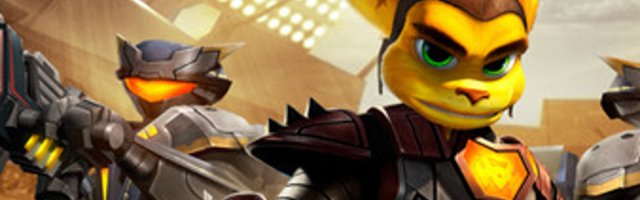
From the Top: Ratchet: Deadlocked
Welcome back to my stubborn obsession with playing through every game in the Ratchet & Clank franchise that I can get my mitts on. If this is your first foray into my article series, I recommend checking out the earlier episodes, as this is a continuous ponderation on the games’ evolution, mechanical changes, and story progression.
If you’ve been following along as I play through these titles, you may recall I have mentioned liking both the arena battles and Galactic Ranger missions. As such, one would imagine I would absolutely love a game that is basically just that stretched over a nine-hour narrative… well, you’d not be wrong, but. Enter, Ratchet: Deadlocked, the fourth entry in the mainline series.

Released in 2005, one year after Ratchet & Clank: Up Your Arsenal, the game picks up pretty soon after the events so far. Sasha has become the Galactic President (I wonder if the position of leader of the solar system is matrilineal), and Ratchet, along with his trusty partner, Clank, and Big Al, have been given command of the starship Phoenix.
Their leisurely afternoon is cut short, however, as a group of robotic combatants beams in and captures the trio, shipping them off to a lawless section of space, the Shadow Sector. It turns out the region is home to a massively popular reality gladiator deathmatch show known as DreadZone (hosted by Vox Industries), and Ratchet has been signed up, willing or not. Equipped with explosive collars and forced to fight for the entertainment of billions, the trio begin to plan their escape from, and the thwarting of, the blood sport.

Deadlocked is a bit of an odd duck in the franchise, as it feels like a mainline entry, but is also different enough to be considered a spinoff, at least on a mechanical level. You see, as I mentioned in the opening paragraphs, this is not a planet-hopping platforming adventure, like previous games.
Now, at a higher level, Deadlocked seems similar: we travel to varying planets to complete objectives. However, instead of having a linear level to explore at the player's leisure, the game is divided into small challenge arenas and short missions — about five-ish minutes per instance. These operations are usually some kind of firefight, but they can also contain vehicle sections or special tasks.
The biggest difference in the game, however, is hinted at in the title: Ratchet: Deadlocked. This is the first time in the franchise’s history that our robotic ally, Clank, is shunted onto the sidelines for the duration of the experience.

Now, Clank does have a presence in the game and narrative, acting as Ratchet’s support. He’ll give information on the current objective, offer helpful hints, and comment on key happenings in the story. It is implied that Clank is also working with other characters to orchestrate an escape, while Big Al, the team's tech expert, experiments with disconnecting the Deadlock collars. Both characters can be seen (though not interacted with) in the holding facility that acts as a central hub.
Despite his allies being otherwise occupied, our blaster-slinging hero thankfully isn’t completely alone! Taking up the role of your battle buddy are two refurbished bots, Merc and Green, who will fight alongside Ratchet and perform many utility tasks. As a sidenote, the two helpers are replaced by a beefed-up, or Alpha, Clank if players engage in co-op.
Mechanically, this is a pretty big change and the ultimate form of the series’ move to a third-person shooter. Starting with movement, Deadlocked eschews the series staple scheme in favour of a strafe-locked approach. Instead of freely walking about and engaging strafe mode by pressing a button, Ratchet now strafes by default. Additionally, the shoulder buttons are now used to fire the current weapon, in addition to jumping, of all things. It is a bit of a lurch at the beginning and takes time to get used to.

Ratchet’s lack of his robotic buddy also affects his vertical capabilities. Whereas in previous titles our hero could perform a high jump or hover with Clank’s aid, he is now bound to a simple double jump. This lack of aerial movement is also evident in the level design, as platforming challenges themselves are pretty infrequent and more horizontally inclined.
Finally, the addition of Merc and Green shifts the core gameplay loop in odd ways. Though the hovering duo are useful allies in combat, their true purpose is to occupy a more supportive role. They turn bolt cranks, provide Ratchet with temporary grind rails, and even hack machinery. Whilst this does make sense in-game, our favourite Lombax being too busy fending off waves of enemies to bother with anything else, it does take away a lot of the game's identity. Ratchet’s only useful action is, in essence, to fight.

The missions and challenges our group, named Team Darkstar for whatever reason, face are a nicely varied collection of gameplay types, ranging from simply getting from one location to another to escaping a planet about to implode. Each location visited has a main story segment that includes a set of operations to complete, along with optional side content.
The operations themselves are weirdly short, usually clocking in at about an average of five minutes. While there are multiple parts to one whole, clearing a single planet is a disconcertingly quick experience, making the experience feel very rushed. This feeling is exacerbated by the fact that most of the plot progression is done between locales or during the rare visits to the central hub, making everything happening in the locations themselves feel inconsequential.
The areas allocated for each leg of a challenge are also somewhat small, leaving little reason to explore or go off the beaten path. This is a shame, as the planets we visit during the playthrough do offer some interesting settings to explore. Ancient burial grounds for robots, the Blargian homeworld, a gothic cathedral, all blazed past without really stopping for a breath. Regardless of this missed opportunity, the levels are nicely varied at least and do display some of the franchise's charming creativity.

In terms of mission types, three main categories can be identified: adventure, survival, and vehicle. Adventure challenges are the closest Deadlocked gets to feeling like a Ratchet & Clank game, featuring a linear level to fight through with some light platforming or puzzle elements. This type of segment is probably the most common and lengthy on offer.
The survival variant is basically the arena challenges seen in earlier titles: restricted to a small area, Ratchet and co. must fend off waves of enemies, possibly while performing a separate task. A common example of this is having our hero deal with foes while Merc and Green hack some device or crank a bolt.
Finally, vehicle sections are possibly the most varied, featuring four distinct forms of transport. The Landstalker, a giant four-legged walking turret, and the Hovership are often used in missions where the player must destroy enemy fortifications or eliminate groups of foes scattered around the map. The Puma, an armoured jeep fitted with a cannon, is used in these types of missions on occasion, though it also features in a checkpoint race-style task.

Finally, the Hoverbike makes a return, being mainly used in time-trial missions. The vehicle is otherwise unremarkable, however, I am convinced that it has been made to control and sound like the A-Grav Zoomer from Jak and Daxter: The Precursor Legacy. As the two series have often referenced and poked fun at each other, it’s not impossible this is an intentional nod, although it does feel strangely out of place.
Now, most of the missions in Deadlocked feel like the arena challenges we’ve seen in earlier titles, as stated. Regardless of that shift in design, the game does still have an actual arena segment! As Ratchet succeeds in his new gladiatorial occupation, he will slowly gain Dread Points and Medals. Once enough are collected, our hero will take part in a mandatory promotion match in the DreadZone arena.
These matches operate much in the same way as in Ratchet & Clank: Up Your Arsenal, mixing both combat and platforming sections into short challenges. The bouts are usually finished off with a boss battle against one of the main antagonists of the title: the Exterminators. If Ratchet emerges victorious, he is given a new suit of armour to signify his new rank.

In terms of my favourite feature in the series, creative weapons, the game is a bit of a let-down. Featuring only 10 guns (including a few returning models), this is easily the smallest arsenal to date in the franchise. However, what the title lacks in weapon variety, it does try to make up for in both upgrade levels and modifications… with mixed results.
In the titles so far, armaments have had a maximum level of five, with the final stage having the ordnance transforming into a new form. While the blueprint is still the same in Deadlocked, things are taken to a new height this time around as the weapons are now capped at level 10 (at least during the first playthrough).
This may sound good on paper, as hey, more levels. Regretfully, it doesn’t hold up very well in practise, making gun enhancement feel very long-winded. As the increase in damage per upgrade is rather small, they aren’t very exciting. This was also the first entry in the series where I had trouble maxing out all of my armaments before the adventure was over!

To its credit, the game does make a fun addition to the power-up screen, actually showing a numeric value to represent how much stronger a specific gun has become. It’s a nice touch, though it does also make clear just how much more powerful some weapons are in relation to others.
The new feature introduced, weapons-wise, is the Alpha and Omega modifications. The former are unlocked on a per-gun basis whenever it levels up. The mods mainly increase the existing stats of the armament, such as firing speed or ammo capacity, or add some of the series’ staples, such as lock-on capabilities.
The Omega mods, on the other hand, are a more complex beast. Instead of being gained naturally, these additions need to be bought from a vendor, just like the boomsticks themselves. Once acquired, they can be installed into a weapon in the inventory screen (with some mods being restricted to specific types of guns). The effect that an Omega attachment has is much more prominent than that of its Alpha counterpart, adding elemental damage or other features.

For example, Deadlocked does not have a dedicated “transform enemy into an animal” ordnance, but instead offers a Morph mod that can have any weapon do the job! As the Omegas are freely disabled or switched, with no limit to how many tools use the same flavour of destruction, it is a pretty fun system for weapon customisation. However, it does feel a bit tacked on, while also making the guns themselves feel less unique.
Now, moving on to the armaments themselves, the game’s armoury isn’t exactly ground-breaking. Things start off interesting with the first dual-wielded blasters, the Dual Vipers, but quickly conform to the usual blueprint of bomb-throwing tool, shotgun, and rocket launcher.
In terms of returning favourites, the Turret Launcher seen in previous titles is back, as well as Up Your Arsenal’s Holoshield. Surprisingly, the latter is much better this time around, launching a protective wall with a clearer indication of when it’s about to disappear. Kudos!

Although I didn’t really click with any of the weapons on offer, there were two that I think deserve note. First off, Deadlocked continues the tradition of introducing melee weapons with ammo in the form of the Leviathan Flail. This giant, chained ball can be slammed onto the ground for a great area of effect attack. Paired with a respectable rate of “fire” and decent damage, it was my go-to stick whenever I found myself surrounded.
The second noteworthy gun was the Hunter Mine Launcher, a sort of combination of the Mine Glove and Bouncer from previous games. When fired, the weapon would throw out a small, hovering explosive orb that remains stationary. As enemies get close, however, the ball-o-death would activate and start homing in on foes, detonating on impact. It does a fair bit of damage per pop and adds a small bit of strategy to the whole, which was appreciated.
Finally, we do have a late-game super cannon, as is tradition. While it is not of the RYNO series, Deadlocked does note this within the lore, having the gun in question, the Harbinger, be a competing brand of apocalypse, designed by Vox Industries. The armament itself is pretty hit-or-miss (literally).

Once fired, a small swarm of satellites shoot off into space, which then aim and deploy devastating lasers onto the battlefield. While very impressive to watch (and deadly on hit), the thing kept missing my targets, which was pretty aggravating considering it’s very low ammo capacity. I’d go for the RYNO any day, sorry Vox.
Much like the RY3NO, the Harbinger can be upgraded into the Supernova with use. Weirdly, the transformation doesn’t actually seem to change anything in the gun beyond a cosmetic shift.
On a separate note, Deadlocked does bring back the Omniwrench upgrades seen in Going Commando, although as more generic, purchasable items from the vendor. Though most just up the damage of the tool, a few of the endgame variants add fire damage to the mix, which is novel if nothing else.
Before we get into the enemies and characters, the game does have one more avenue of purchasable improvements: your battle-bot buddies! Only available in the central hub area, the Bot vendor offers three types of upgrades: cosmetic skins, tools, and armour. Starting off with the latter two, they are pretty simple.

After certain plot beats (usually a promotion tournament), new items will be available. The improvements to armour only really increase how sturdy your robot pals are, whereas the tools include both helpful devices, such as a shield generator, as well as a few weapon options, like a sniper rifle. I’ll be honest, I didn’t really notice the duo utilising the guns I bought them, though I may have just missed it due to the hectic nature of the battles.
The cosmetics are new colour schemes for the mechanical warriors, as well as a few different styles of head. While a nice touch in itself, the developers did go the extra mile of naming the different skins after in-game planets or armed forces, making for a nice bit of world-building, even if it doesn’t amount to much.
The enemy design of Deadlocked is… a bit bland, to be honest. Things start off strong, with a mix of generic robotic foes and “undead” machines, but it doesn’t really go anywhere from there. The pool of baddies is rather small, seeing very little change between levels, meaning we fight the same androids, monsters, or bots from planet to planet. Sure, the number of combatants and enemy configurations change, but it gets pretty old pretty fast.
The main bosses of the DreadZone tournament are the Exterminators. Although an attempt is made to give them a bit of personality, it regretfully falls pretty flat. The two mechanical members, Shellshock and Reactor, are almost interchangeable, and the Eviscerator, an assassin-esque mantid, has zero lines in the game as a whole!

Ace Hardlight, the penultimate antagonist and leader of the group, thankfully, is more fleshed out. Seeming to be a dark, greedy reflection of Ratchet, this former hero is meant to show what our Lombax protagonist could become if he took up the gladiator gig in the long run… however, even with the extra attention, Mr Hardlight is a pretty forgettable enemy. We only face him once in the final promotion tournament, with him kinda just… dying off-screen? It’s all very rushed.
The true big bad of the story is the producer of the blood games and owner of Vox Industries, Gleeman Vox. Though the man isn’t an active threat until the very end, he is very much the malice behind most of the unfortunate events of the narrative. Portrayed as the stereotypical money-hungry CEO, Vox is a surprisingly fun character. The guy even voices his own commercials! I also enjoyed Vox’s biggest beef with Ratchet being that the little guy’s merch sold better than Hardlight’s. A true capitalist.
His boss fight, however, is a boring fight with a giant mech, so boo to that.
In terms of other memorable characters, there is honestly little to say. We do catch a glimpse of a few other contestants near the very end of the game, but otherwise it’s a slim showing. Interestingly, one of the best things about Deadlocked is the team of commentators who narrate just about everything.

As DreadZone is a holovision program, Vox has hired a duo to commentate on the happenings on screen, much like any proper sport. The duo, consisting of the robotic Juanita Alvaro and the fleshy Dallas Wanamaker, have great chemistry and some honestly funny back-and-forth. They spend the majority of the game absolutely bashing Ratchet, which is to be expected from the show, but they manage to squeeze in a quick change-of-heart as things wrap up.
Dallas is my absolute favourite, as his deliveries are good for a laugh and have a manic energy that's hard not to be enamoured with. It helps that he is voiced by Darran Norris, also known for his portrayal of Cosmo in The Fairly OddParents.
Our main cast is generally quite blasé, with Clank, Ratchet, and Big Al receiving very little in terms of character progression. Ratchet himself seems a bit off, being surprisingly nonchalant, if not eager, about his new role as a gladiator. It takes a sound berating by Clank to get our gunslinging hero to realise that people are being abducted and killed on the daily, which feels very out of character at this point.

In a tonal shift out of absolutely nowhere, Big Al is actually shot and critically injured at about the two-thirds mark of the game, being taken into intensive care. The event itself is very sudden and does wonders to make the player hate the perpetrator, Ace Hardlight, but it’s such a weirdly jarring scene to add!
Luckily, Big Al does indeed survive, though much of his body is reconstructed from robotic parts, giving him a half-humanoid, half-robot look. The new design suits the man, him being a robotics expert and all, though I believe his synthetic side is quickly forgotten in future instalments, making the whole contrivance an unnecessary wash.
Finally, we do get a few silly cameos as the credits roll. Captain Qwark gives our trio a call as they fly to safety, and we even see Nefarious and Lawrence float by on the hunk of space debris they were stuck on after the events of Up Your Arsenal! Though only thrown in as a gag, it’s nice to get a bit of a continuity nod from the game itself.

Ratchet: Deadlocked is, for me, a weird experience. On the one hand, it is clunky, repetitive, and short-lived, representing a gigantic leap away from a lot of my favourite aspects in the franchise. However, on the other hand, it is brainless fun that's easy to pick up and play for a bit at a time. Honestly, this may be the game I replayed the most of the series simply because it’s so easy and quick to play!
The title is a fun little excursion into a more action-oriented direction. Though I did enjoy playing it again, I’m glad Insomniac Games decided against the new style of gameplay. Definitely not in my top five, but still worth a play through at least once.
With that, the PlayStation 2 era of Ratchet & Clank comes to a close, and we begin the arduous trek toward the Future trilogy of the PlayStation 3. Before then, however, we will be making a slight detour into the wondrous world of the handheld entries Ratchet & Clank: Size Matters and Secret Agent Clank. This will also be our first foray into games not developed by Insomniac!

GameGrin are proud to have all their articles researched, written, and edited by real people that care about gaming.


COMMENTS