
Moving Pictures: Celebrating 30 Years of Whisper of the Heart — What Changed from the Manga to the Adaptation
Everyone who’s ever watched a Studio Ghibli film would be lying if they said they didn’t have a favourite. So, with the 30th anniversary of Whisper of the Heart arriving, I felt that it would be a great time to discuss my favourite Ghibli film.
So, Whisper of the Heart was first released in Japanese cinemas on 15th July, 1995, and was based on Aoi Hiiragi’s 1989 manga, Mimi o Sumaseba. While Hayao Miyazaki did write the screenplay for the adaptation, it was directed by Yoshifumi Kondo, with the film serving as his directorial debut. Prior to this, he had worked in key animation, production, character design, storyboarding, and had also worked as an animation director on a host of anime TV series, such as the 1979 Anne of Green Gables adaptation. So, Kondo was no newbie, as he’d been working in anime since as early as the 1960s.

The overall movie follows Shizuku, a young girl who lives in an apartment with her parents and older sister. With her sister preparing to move out, her father working in a library, and her mother doing a university degree, Shizuku struggles with the idea of what she wants to do. With no motivation to study, she spends most of her time reading books, but is drawn to the mysterious Seiji Amasawa, who always takes out a library book before her. However, she’s annoyed when she discovers that a boy who grates on her nerves is the same one she’s glorified in her mind.
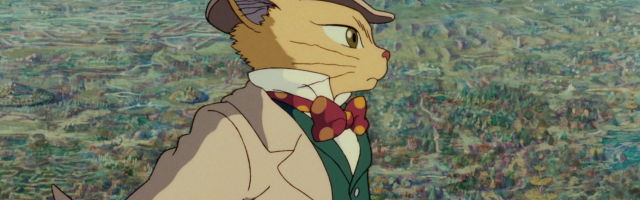
Seiji Amasawa’s grandfather runs an antique shop that does restorations for different items, and Shizuku happens to meet him after following a cat to his shop. While there, she becomes engrossed with a statue of Baron Humbert von Gikkingen; a cat wearing a suit who ends up inspiring her to write her own story about him. Unbeknownst to her, Seiji is close to his grandfather and makes violins in the basement of his shop in the hopes of going to Italy to study how they’re made. It leads to an unexpected relationship blossoming between the two of them, and with Seiji convincing his parents to allow him to follow his dreams, she finds the courage to write an entire first draft of a story, realising that’s what she wants to do.

While her parents don’t agree, they allow her to do her mysterious project so long as she still studies for her exams afterwards. She accepts, and when showing Seiji’s grandfather her work, he is proud and notes that Seiji was just as nervous when he made his first violin. While anxious of what he thinks, he acknowledges that, like a geode, it just requires polishing to reach its full potential. Then, after finishing the draft, Seiji returns from Italy, and he asks Shizuku to marry him when they’re older.
I’ll admit, the summary I put up doesn’t quite do the film justice. However, I can’t lie that I’ve always seen myself in Shizuku. As a younger child to a much more educationally-inclined sibling, I struggled with what I wanted to do. I would also lose myself in books, and sometimes, it takes meeting other like-minded friends to get you to seek introspection. Whisper of the Heart taught me that everything is hard at first, but if you work hard, you’ll be happy, even if you’ve just written a first draft.

The biggest point of Whisper of the Heart is that it counters the whole idea that if you study hard, you’ll inevitably get a good job. Shizuku doesn’t want to just study: she wants to create, and considering the more coming-of-age drama aspect of the film, it stands out. The romance is essentially secondary, as the real victory is discovering that she can make her own story.
However, while that’s my personal opinion and summary of the film there, I also wanted to look at it as an adaptation. So, I did go looking for the Mimi o Sumaseba manga to see what it was based on, and how it differed. Plus, finding a 1989 manga is a lot more difficult, as this was never officially translated into English, but I did find a good fan translation online.

The manga itself is only four chapters, and it differs from the adaptation a lot. While it’s still cute, I think I understand the reason for why Miyazaki and Kondo made some changes. See, in the manga, Seiji has an older brother, Kouji, who is dating Shizuku’s older sister, Shio. While there is still the same subplot of Shizuku having to navigate her budding feelings for Seiji whilst contending with her friend Yuuko’s crush on their other friend, Sugimura, who has feelings for Shizuku, it felt like it was more drawn to the romance than the movie was.
In terms of Kouji Amasawa, he was interested in photography, while Seiji, instead of being interested in violin-making, was more interested in painting. Seiji and Shizuku argue about fantasy novels, and it appeared that both of them were interested in each other after seeing the other’s name pop up. Plus, both brothers have a cat they’ve bonded with, Luna and Moon; they’re just two black cats instead of one fat cat with a moon-shape that we see in the film.

Then, there’s Baron Humbert von Gikkingen. In the manga, we only know him as Sir Cat, and he’s not for sale. While this is also true in the anime, the story differs. In the manga, Seiji’s grandfather agrees not to sell him until his sweetheart is created, but the war meant that the artist who made him had probably been killed. However, in the film, his first love was the one who held onto the companion statue, and the two were, instead, separated by the Second World War. It offers a more bittersweet sense of loss compared to the manga.
While both are great, and I do hope that Aoi Hiiragi’s manga does get officially licensed and with an English distribution, I still prefer the film. Compared to how we usually see adaptations, Ghibli has always been less stringent in matching the source material exactly, and in this case, it works wonders. When you watch Whisper of the Heart and read Mimi o Sumaseba, the two are just so completely different works, and each one has its own strengths, while still conveying the overall same theme.


COMMENTS